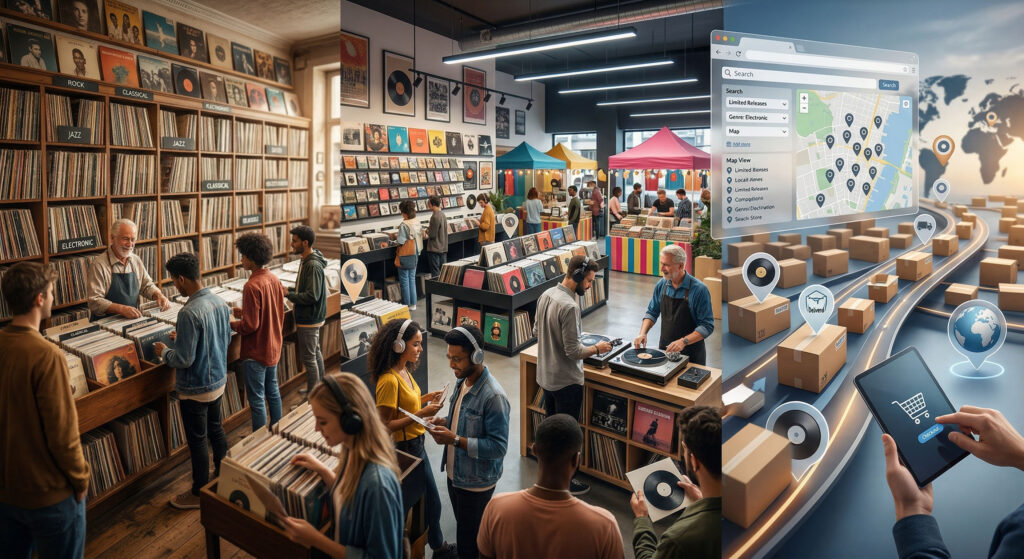
Local record stores for discovery, community, and records you can inspect before buying. New online retailers (Amazon, direct label sites) for current releases with reliable condition. Discogs for used records from around the world — by far the largest selection, but requires knowing how to read condition grades. Thrift stores and estate sales for occasional gems at minimal cost, with no guarantees. Each has a different risk profile and a different reward.
One of the genuine pleasures of vinyl is that buying records is itself an activity — not just a transaction. Flipping through crates in a record store, finding an unexpected pressing on Discogs, pulling a familiar album off a thrift store shelf for a dollar: these are experiences that streaming has no equivalent for. Understanding where to look, and what to look for, makes every one of those experiences more rewarding.
Where to Buy Records — Four Sources, Four Different Experiences
Most independent stores carry a mix of new releases and used stock. New records are priced at standard retail ($24–35 for standard LPs, $35–60 for audiophile pressings). Used stock varies enormously — common titles can be found for $3–10, rarer pressings can be hundreds.
Find your local store: vinylhub.com maintains a worldwide map of independent record stores. In the US, any store carrying the “indie” designation participates in Record Store Day — a good sign of community engagement and quality curation.
- Inspect condition before buying
- Discover unexpected records
- Staff knowledge and recommendations
- No shipping risk
- Support local music community
- Selection limited to what’s in stock
- May not carry niche genres
- Prices on used can be higher than online
- Not available everywhere
Bandcamp deserves specific mention: buying directly from artists on Bandcamp sends the highest revenue share to the artist and often includes exclusive pressings, colored vinyl, and signed editions. If the music exists on Bandcamp, buying there is the best value exchange in recorded music.
Price range: standard new LPs $24–35. Audiophile 180g pressings $35–60. Limited or colored editions $35–50. Box sets vary widely.
- Factory condition — no grading needed
- Specific releases easy to find
- Often includes exclusive variants
- Returns accepted at most retailers
- No used market pricing
- Shipping can damage records
- New pressings vary in quality
- No discovery browsing
The platform uses the Goldmine grading standard: M (Mint), NM (Near Mint), VG+ (Very Good Plus), VG (Very Good), G+ (Good Plus), G (Good), F (Fair), P (Poor). Understanding these grades — and their limitations — is essential before buying used records on Discogs. See the grading guide below.
Key features: Sales history shows actual sold prices for any specific pressing — the most reliable price reference in vinyl. Seller feedback ratings (check sellers with 100+ transactions and 99%+ positive feedback). Filter by country of origin, pressing year, and sleeve condition.
- Largest selection of any platform
- Sales history for fair pricing
- Find specific pressings and editions
- Often significantly cheaper than new
- Seller feedback system for trust
- Grading is subjective — varies by seller
- Shipping from overseas adds cost and risk
- Returns can be complicated
- Learning curve for new buyers
The strategy: bring a flashlight and a cleaning cloth. Inspect under light before buying. Common classics (Fleetwood Mac, Eagles, Led Zeppelin, Michael Jackson) are always available cheaply — save budget for anything less common that looks promising. Budget $20 at a thrift store, expect 50% of what you buy to be disappointing, and the remainder to be a genuine discovery.
Estate sales occasionally yield entire collections in excellent condition from careful original owners — these can be exceptional finds. Follow local estate sale listings.
- Extremely low prices ($1–5 typical)
- Physical inspection before buying
- Unexpected discoveries
- Zero shipping risk
- Condition often poor or unknown
- Selection random and unpredictable
- No returns
- Requires cleaning before playing
The Goldmine Grading Scale — What Every Grade Actually Means
When buying used records on Discogs or from any dealer, every listing includes a condition grade for both the record and the sleeve. Understanding what these grades mean — and what the realistic expectations are — prevents disappointment.
Buy
Buy
Usually buy
Price dependent
Avoid
Do not buy
The Goldmine standard defines each grade clearly, but individual sellers apply it differently. One seller’s VG+ is another’s VG. On Discogs, always check the seller’s feedback rating and number of sales before buying. High-volume sellers (500+ sales, 99%+ feedback) tend to grade more consistently and professionally. On a $5 record the risk is low; on a $50 record, message the seller first and ask if the record has been play-graded (listened to, not just visually inspected).
How to Inspect a Used Record Before Buying
Realistic Price Guide — What to Expect to Pay
On any Discogs release page, the Sales History tab shows what copies of that exact pressing have actually sold for, including condition grade and date. This is the most reliable price reference in vinyl. Listings can be priced at anything — sellers price high hoping for uninformed buyers. Sales history shows what informed buyers have actually paid. Before buying any record for more than $15, check the sales history for a realistic price range in the condition you want.
Start at your local record store with a short list of albums you already love. Buy them on new vinyl or in VG+ condition from a reputable seller. Play them on a clean stylus. Notice what vinyl sounds like on music you know well. Then — and only then — start exploring: thrift stores for cheap experiments, Discogs for specific pressings, record store bins for discoveries. The best collection is built slowly, one record at a time, from a position of knowing what you’re listening for.
Buying records is not just supply chain management — it’s one of the pleasures of the format. Local record stores offer what no algorithm can replicate: the chance to find something you didn’t know you were looking for. Discogs offers what no physical store can: every pressing of every record ever made, from sellers around the world. Used records in VG+ condition from reputable sellers are frequently better value than new pressings of the same material. Know the grading scale, inspect before buying when possible, and use sales history rather than listing prices as your price reference. The rest is browsing, listening, and enjoying the ritual.
Interested in the products mentioned? Shop Arkrocket directly:
Browse Arkrocket Record Players →