Vinyl 101 · Unit 3 · Lesson 3.4
The honest answers
Can warped records be fixed? Sometimes — mild dish warps and slight bends often respond to flattening methods. Severe S-warps and edge warps frequently cannot be fully restored.
Will a warped record damage your record player? A mild warp is usually fine. A severe warp causes the stylus to repeatedly lose and regain groove contact, which stresses the stylus and accelerates wear on both the record and your Arkrocket record player’s cartridge.
Is it always worth trying to fix? Only if the record matters to you. For a $3 charity shop find, probably not. For a first pressing or sentimental favourite, absolutely try.
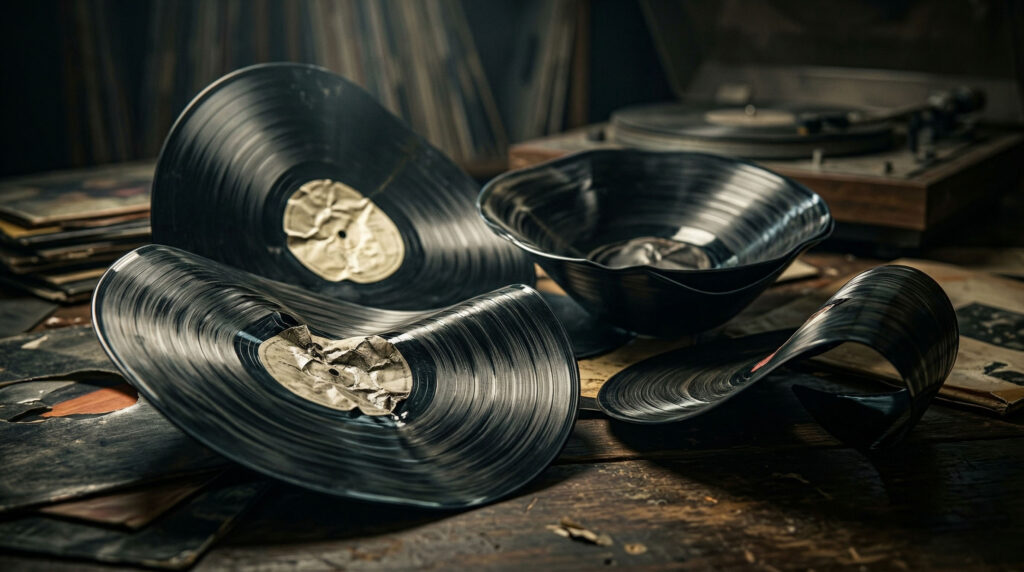
A warped record is one of the more demoralizing discoveries in vinyl collecting — you pull out a favourite album, drop the stylus on your record player, and instead of music you get a seasick wobble as the platter turns. The sound speeds up and slows down as the groove rises and falls. Sometimes it skips. Sometimes it just sounds wrong in a way that’s hard to describe.
The good news is that warping is almost always preventable. And mild warps are often fixable. The key is understanding what causes them, how to assess severity, and which fix method gives you the best chance of success.
How bad is it?
Warp Severity — From Annoying to Unplayable
Flat — no warp
Record sits level on the platter. Plays perfectly on any record player.
Perfect
Dish warp — subtle bowl shape
Visible only when held at eye level. Usually plays fine on a well-set-up record player. Stylus tracks through the gentle rise without losing contact.
Usually playable
Moderate warp — visible wobble
Platter visibly wobbles during play. Stylus may lose groove contact on peaks, causing intermittent skips or pitch instability. Worth attempting to fix.
Try fixing
Severe S-warp
Record twists like a potato chip. Stylus repeatedly slams into rising groove walls. Can damage stylus and record. Difficult or impossible to fix fully.
Hard to fix
Edge warp — sharp outer bend
A pronounced kink at the record’s outer edge — where the stylus starts each side. Often causes immediate skipping at the beginning of every track.
Often permanent
Why records warp
Four Causes of Warping — All Preventable
🌡️
Heat
The most common cause. Vinyl softens at temperatures above 140°F / 60°C — easily reached inside a parked car on a warm day, near a radiator, or in direct sunlight. The record softens, gravity does the rest.
📚
Horizontal stacking
Records stored flat with others stacked on top. The weight of the stack creates uneven pressure over time — the records below develop a permanent dish shape. Always store vertically.
📐
Leaning at an angle
Records stored vertically but leaning — because the shelf is too wide or the collection too sparse. The record takes the shape of its lean over weeks or months. Keep records perfectly upright with dividers.
🏭
Manufacturing / pressing defects
Some records warp during or after pressing due to uneven cooling or quality control failures. Coloured and transparent vinyl are more prone to this than standard black vinyl due to different thermal properties.
The car is the most dangerous place for vinyl
A car interior can reach 130–160°F / 55–70°C on a warm sunny day within minutes — well past the temperature at which vinyl begins to soften. A record left in a car boot or back seat in summer can warp beyond any possibility of repair in under an hour. Never leave records in a parked car. Transport them in a bag kept away from direct sun and heat, and bring them inside immediately upon arrival.
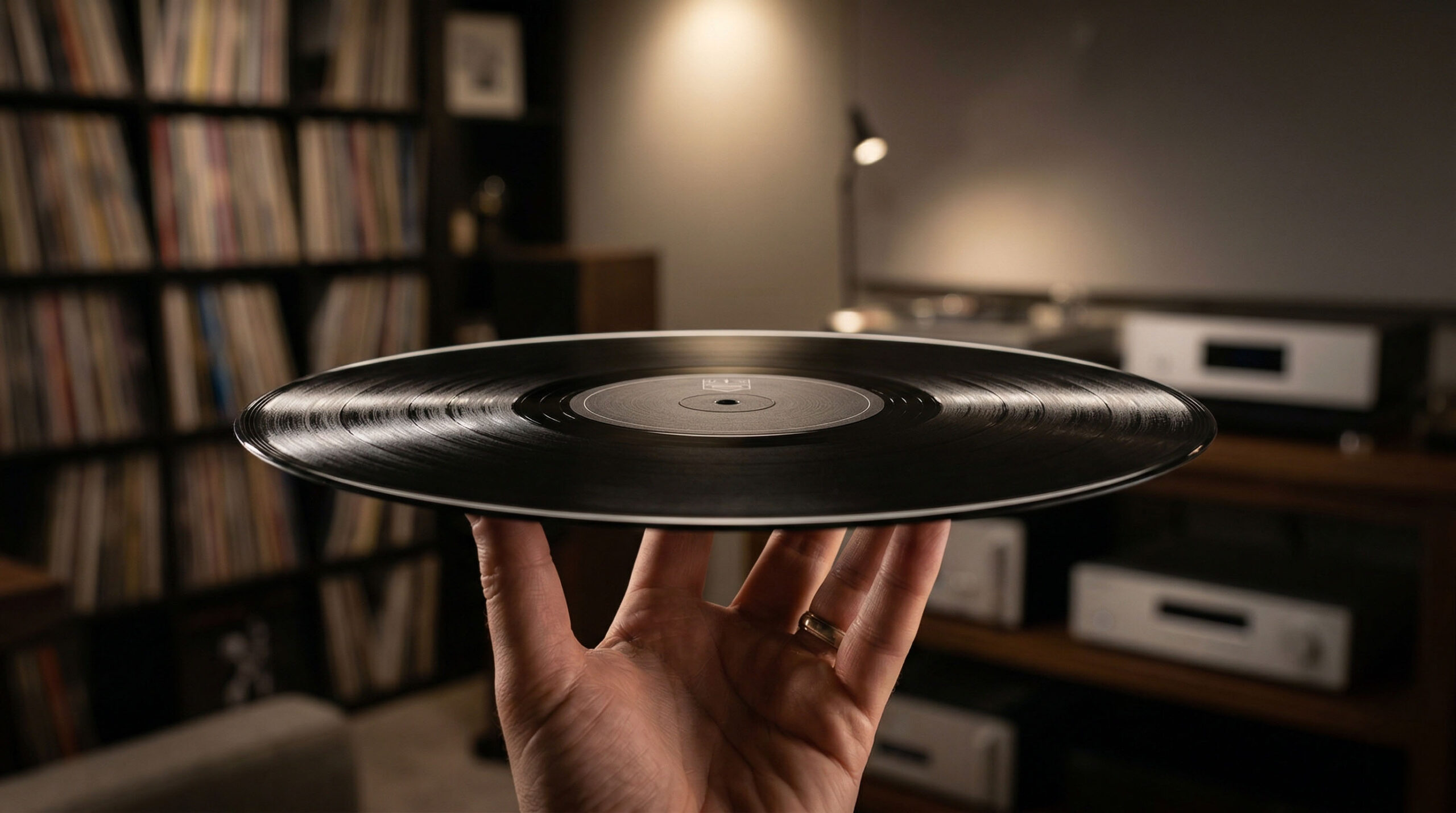
How to check for warping: hold the record horizontally at eye level under a good light. A flat record shows a perfectly level surface. Any curvature, bowl shape, or edge bend is visible immediately this way — use this check whenever buying used records.
Can it be fixed?
Three Ways to Flatten a Warped Record — Ranked by Safety
📖
Method 1 — Heavy weight pressure
Safest
Free
Weeks–months
The gentlest and safest method — no heat involved, zero risk of melting or damaging the record. Works well for mild to moderate dish warps. Will not fix severe S-warps or sharp edge warps.
→Clean the record thoroughly before applying pressure — debris forced into grooves under weight can cause permanent scratching.
→Place the record inside a clean inner sleeve between two heavy, flat hardback books.
→Stack additional weight on top — more books, flat boards. Distribute weight evenly across the whole surface.
→Leave undisturbed for 2–8 weeks. Check periodically. A minor warp may resolve in days; a deeper one needs months.
🛠️
Method 2 — Dedicated record flattener (Vinyl Flat)
Recommended
~$100–300
Hours
A purpose-built device that applies controlled heat and pressure specifically designed for vinyl. The Vinyl Flat is the most popular option — trusted by over 9,000 collectors with a 4.7-star rating. Far safer than DIY oven methods because it controls temperature precisely and clamps the record evenly on all sides. Best choice for valuable or sentimental records.
→Clean the record before flattening — grime under pressure can damage grooves.
→Insert the record into the device and hand-tighten the clamping system.
→Place in an oven at its lowest setting (~100–120°F / 38–50°C) for the recommended time, or use at room temperature for a slower result.
→Cool with the record still clamped inside — 45 minutes minimum. Never remove while warm.
→Play on your record player to assess. Repeat if needed.
🔥
Method 3 — Glass sandwich in oven
Use with caution
~$10–20
Hours
A popular DIY method — place the record between two flat panes of tempered glass, heat gently in an oven, then cool slowly under weight. Can produce good results on moderate warps, but carries real risk of irreversible damage if temperature is too high or the glass is uneven. Only attempt on records you’re prepared to lose.
→Use tempered glass panes — regular glass can shatter when heated.
→Preheat oven to its absolute lowest setting — 100–120°F / 38–50°C maximum. Use an oven thermometer to verify.
→Place the record between the glass, put in the oven for 20–30 minutes.
→Remove carefully, add weight on top, and allow to cool completely at room temperature before playing on your record player.
→Never exceed 120°F — higher temperatures melt grooves permanently.
Can a record weight on your record player help?
A record clamp or weight — a heavy disc that screws or sits on the spindle — applies downward pressure to the center of the record during play. For mild dish warps, this can significantly improve tracking by holding the record flatter against the platter while it spins. It won’t fix a warp permanently, but it can make a mildly warped record playable on your Arkrocket record player that would otherwise cause problems. An inexpensive and non-destructive first step before attempting any flattening method.
Prevention is always better
How to Prevent Warping — Simple Rules That Work
Every warped record in a collection represents a storage or handling mistake at some point in that record’s life. The good news: all the common causes are completely avoidable with a few consistent habits around your record player and storage area.
✓Store vertically, always — standing upright like books on a shelf, with dividers to keep them from leaning. This is the single most important storage rule.
✓Never leave gaps on the shelf — records without support on both sides lean and gradually take the shape of their lean. Fill gaps with dividers.
✓Keep away from heat sources — radiators, sunny windows, electrical equipment that generates heat. Maintain storage at 65–70°F / 18–21°C.
✓Never leave records in a car — even a few minutes of direct sun can begin the warping process. Transport in a bag, bring inside immediately.
✓Avoid attics and garages — both experience extreme temperature swings that are precisely what warps vinyl. An interior room at stable temperature is ideal.
✓Don’t stack records flat under weight — even a few records stacked horizontally over months creates warping in the lower discs.
✓Remove shrink wrap from new records — shrink wrap continues to contract over time and can warp the record inside. Remove it when you bring a new record home.
Buying used records — check before you buy
When browsing used records, hold each record horizontally at eye level before buying. A flat record shows a perfectly level surface. Any bowl, wave, or twist is clearly visible. Edge warps — a sharp kink at the outer rim — are the hardest to fix and worth avoiding entirely. Moderate dish warps may be worth buying if the price reflects the condition and you’re prepared to attempt flattening.
RecordPlayerLab verdict
Warped records are one of the few vinyl problems where prevention is dramatically easier than the cure. Store vertically, avoid heat, fill gaps in shelves, and never leave records in a car — and you will almost never encounter a new warp in your collection. For warps you already have: mild dish warps are worth attempting to fix with weight or a dedicated flattener, and often respond well. Severe S-warps and sharp edge warps frequently cannot be fully restored. Play a mildly warped record carefully on your Arkrocket record player with a properly set tracking force — if the stylus tracks without bouncing or skipping, the record is playable and no further action is urgent.
← Previous
Lesson 3.3 — How to clean vinyl records
Next →
Lesson 4.1 — MM vs MC cartridge
vinyl 101
warped vinyl records
warped record fix
flatten vinyl record
record player care
Arkrocket record player
vinyl storage
record warping causes
vinyl flat
beginner guide
Interested in the products mentioned? Shop Arkrocket directly:
Browse Arkrocket Record Players →