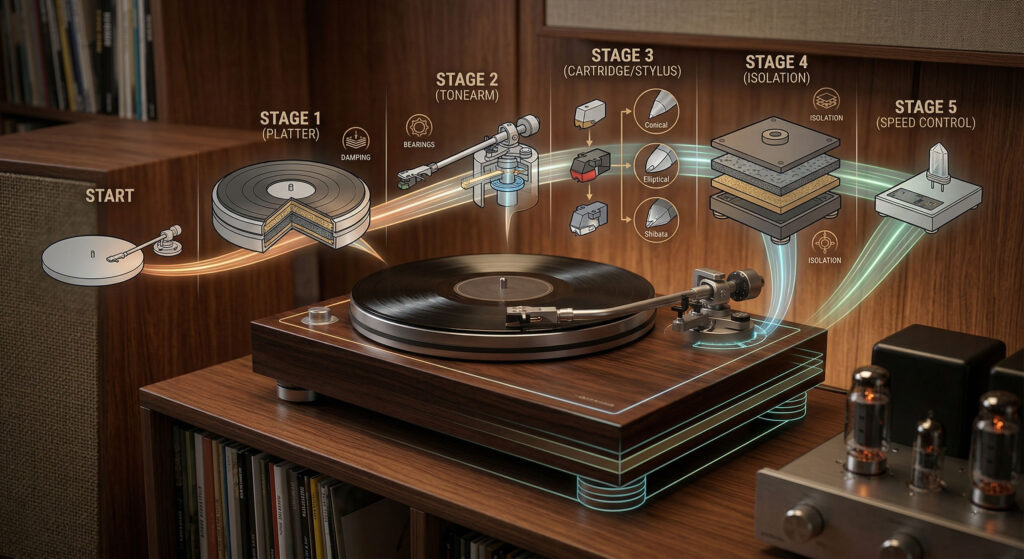
Most upgrade money is wasted because people upgrade in the wrong order. The rule is simple: fix the source before you improve the reproduction. A better stylus on a dirty record reveals more dirt. A better phono preamp on a worn stylus reveals more distortion. A better amplifier on a mediocre phono stage reveals more of the preamp’s limitations. Every upgrade only shows its full value when everything before it in the chain is already correct.
The upgrade path is one of the most enjoyable conversations in vinyl — and one of the most frequently misunderstood. Audiophile forums are full of people who spent $500 on a phono preamp while still playing on a stock stylus that’s three years old. Or bought a cartridge for a record player whose tonearm cannot track it correctly. Understanding the signal chain and where bottlenecks actually live saves money and produces dramatically better results.
The Upgrade Path — Ranked by Return on Investment
$20–80
Immediate, dramatic
For Arkrocket record player owners: the AR-N60 replacement stylus snaps on and off without tools and costs a fraction of what it protects. This is the first action, every time.
What changes: clarity across all frequencies, cleaner high frequencies, lower surface noise, better inner groove tracking, more detail on familiar records. The improvement on a record you know well is often genuinely shocking.
$15–50
Transformative on dirty records
Rule: never evaluate any upgrade on a dirty record. Clean the records first, then assess what remains. Many “upgrade” problems are cleaning problems.
What changes: reduced surface noise, cleaner high frequencies, better dynamics on quiet passages, lower perceived distortion. A previously mediocre pressing can become genuinely excellent.
$50–200
Significant, system-wide
Before upgrading: verify the new cartridge is compatible with your tonearm’s effective mass and the headshell mounting standard. Not all cartridges work with all tonearms. On fixed-cartridge record players (including several Arkrocket models), cartridge upgrade may not be possible without replacing the tonearm/headshell assembly.
What changes: detail retrieval, stereo imaging, transient response, frequency extension at both ends. The character of the sound changes — sometimes dramatically.
$100–300
Noticeable if built-in is poor
When to upgrade: if your record player has a switchable Phono/Line output, you can bypass the built-in preamp by connecting to an external phono stage and setting the switch to Line. Compare the two by ear. If the external sounds noticeably better — cleaner, quieter, more dynamic — the built-in preamp was the bottleneck. Entry-level standalone phono preamps start at $80–150 (Pro-Ject Phono Box, Rega Fono Mini A2D).
What changes: lower noise floor, cleaner dynamics, better RIAA accuracy, improved bass definition and treble clarity. The improvement is system-dependent — on modest cartridges with modest speakers, the difference is subtle.
$150–500
System-limiting if poor
Rule of thumb: budget roughly 50–100% of your record player cost on speakers. A $300 record player sounds significantly better through $200 powered bookshelf speakers than through the built-in speakers or a cheap Bluetooth speaker.
What changes: bass extension, soundstage width and depth, dynamic range, clarity on complex passages. A speaker upgrade often produces the most dramatic perceived improvement because it changes what you literally hear — not just what’s being produced.
$20–100
These are genuinely useful but should come last — investing in a cork mat while the stylus is worn is money poorly spent. The improvement from a platter mat is subtle; the improvement from a fresh stylus is not.
Why System Balance Matters More Than Any Single Upgrade
The single most important principle in audio upgrading: every component should be roughly matched in quality. A system that is highly unbalanced — exceptional at one stage, weak at another — sounds worse than a system where all components are moderate quality and well matched.
The unbalanced system with the exceptional cartridge sounds worse than the balanced system with moderate components — because the budget phono preamp obscures everything the cartridge reveals, while the speakers can’t communicate what the preamp manages to preserve. The balanced system’s moderate components work together; each one can hear and respond to what the previous one delivers.
In audio, inputs matter more than outputs. This means: the cartridge matters more than the phono preamp, which matters more than the amplifier, which matters more than the speakers — in terms of what information enters the chain. No downstream component can recover information that was lost upstream. This is why a fresh stylus on clean records always comes before any other upgrade. Improve the source first; the improvement flows through every component downstream automatically.
What Not to Upgrade First — and Why
A better phono preamp amplifies and reveals everything — including the distortion and noise introduced by a worn stylus. Upgrading the preamp while the stylus is worn often makes things audibly worse: the preamp is now more accurately reproducing the stylus’s degraded output. Replace the stylus first, evaluate, then consider the preamp.
A new turntable played through cheap speakers still sounds like cheap speakers. Before buying a new record player, identify what the actual limiting factor is. Play a known clean record with a good stylus, compare through different output options (headphones directly from the amplifier vs the speakers), and listen for whether the limitation is in the source or the reproduction. Many listeners discover their current record player sounds excellent once the speakers are changed.
Level the record player — a slight tilt causes uneven tracking force on both groove walls. Free to check, immediate benefit.
Clean the stylus before every play — a dry stylus brush costs $10 and removes the contamination that degrades every record it plays.
Separate the record player from the speakers — as covered in Lesson 6.3. Free, and solves a large category of sound quality problems.
Properly set tracking force and anti-skate — a digital tracking force gauge costs $15–20 and ensures the cartridge is operating within spec. No component upgrade compensates for wrong tracking force.
The vinyl upgrade path is a journey that rewards patience and correct sequencing more than budget. Start with a fresh stylus and clean records — these two steps consistently deliver more audible improvement per dollar spent than any component upgrade. Then consider cartridge, then phono preamp, then speakers, maintaining system balance throughout. The Arkrocket record player range is designed as a balanced system at each price point: the AR-N60 cartridge, belt drive mechanism, and built-in phono preamp are matched to work together. Upgrade within that balance, and the improvement compounds. Upgrade out of sequence, and you spend money to reveal limitations you haven’t yet fixed.
Interested in the products mentioned? Shop Arkrocket directly:
Browse Arkrocket Record Players →