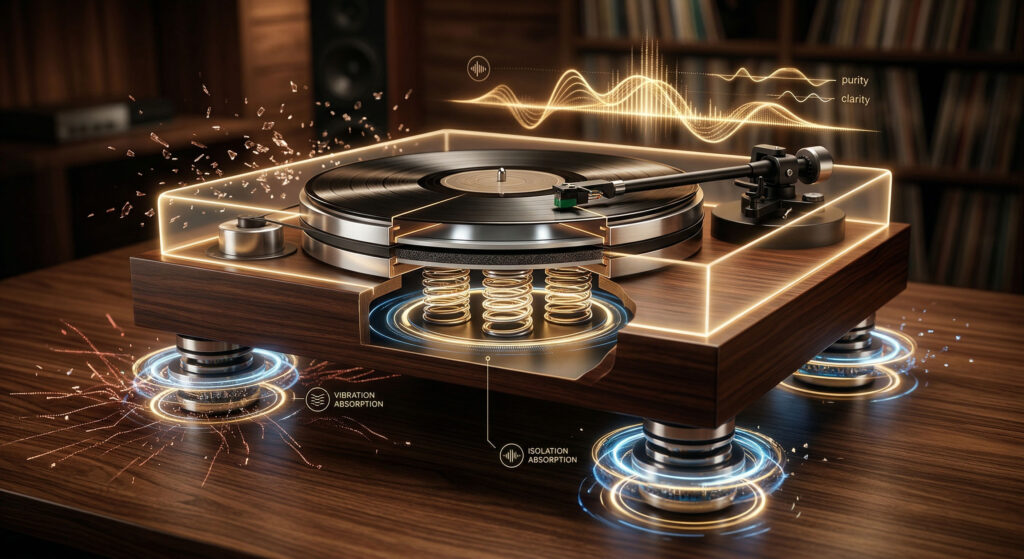
1. Move the record player off the same surface as your speakers — free, immediate, solves most problems.
2. Isolation feet (sorbothane pads) — $15–40, absorbs structure-borne vibration.
3. Isolation platform — $50–200, more mass and damping for persistent problems.
4. Wall-mounted shelf — $40–150 installed, the most effective solution for serious feedback or bounce floors. Completely decouples the record player from the floor.
A turntable is the most vibration-sensitive device in any home audio system. The stylus tracks groove modulations measured in nanometres — changes in position so small they are invisible to any consumer-grade microscope. This extraordinary sensitivity is what makes vinyl sound so detailed. It also means any mechanical vibration that reaches the platter — from speakers, footsteps, appliances, or even traffic — is read by the stylus as noise and added to the music.
Most listening problems that survive cleaning, stylus replacement, and tracking force adjustment turn out to be vibration problems. Understanding where vibration comes from and how to stop it is one of the highest-return improvements available to any record player owner.
Three Sources of Vibration — and Which Is Worst
How Much Isolation You Actually Need
The floor type under your listening room is the single biggest predictor of how much isolation work is needed. Concrete slab construction transmits almost no footfall vibration; suspended wooden floors can be extremely problematic.
Four Ways to Isolate a Record Player — Ranked by Effectiveness
Do this first
Rule: the record player and speakers should never share a surface. The record player goes on a dedicated shelf, table, or rack; the speakers go on stands, separate shelves, or on the floor. If only one change is possible, this is it.
Also consider the floor. If the speakers are on the same floor as the record player, bass frequencies from the speakers travel through the floor and reach the record player’s feet. Raising speakers onto stands or isolating them with speaker isolation pads helps significantly.
5 minutes to install
How to use: place one sorbothane hemisphere under each foot of the record player. Load matters — sorbothane works best when compressed to around 15–25% of its height. Check the manufacturer’s weight rating and match to your record player’s weight.
Limitation: sorbothane is less effective at very low frequencies (below ~20 Hz) — the subsonic rumble from bass-heavy speakers or footfall on a bounce floor. For those situations, a platform or wall shelf is more effective.
Place and level
DIY option: a thick bamboo or maple cutting board placed on sorbothane pads costs $15–30 and performs similarly to many commercial platforms. The IKEA Aptitlig bamboo chopping board ($10–20) on four sorbothane hemispheres is a widely recommended budget solution among vinyl enthusiasts.
Commercial options: Auralex ISO-Tone ($80–100), IsoAcoustics zaZen ($150–200), Fluance IB40 ($90). These add purpose-engineered isolation geometry to the mass-and-damping approach.
Granite or marble slab: extremely effective at reducing high-frequency vibration due to mass and rigidity. Inexpensive as a kitchen tile or offcut from a stone merchant. Place on sorbothane pads. Looks excellent under any record player.
Most effective overall
Requirements: must be mounted into structural wall studs or masonry — drywall anchors alone are insufficient for a record player. The shelf itself should be solid wood or MDF (not hollow or glass). Add sorbothane pads under the record player even on a wall shelf for motor vibration isolation.
Why it works so well: the record player’s vibration path is completely redirected. Footsteps travel floor → joists → subfloor → floor surface, but cannot easily travel floor → wall → wall shelf. The acoustic path is broken at the wall-floor junction.
Not always possible: renters or those without solid masonry walls may not be able to install a wall shelf. In those cases, a heavy platform on the sturdiest available surface, as far from speakers as possible, is the practical alternative.
The Purpose-Built Solution — Arkrocket Statio Audio Rack
A purpose-built audio rack designed with vibration isolation in mind offers a middle ground between a standard shelf and a full wall installation. The Arkrocket Statio Audio Rack is designed specifically for record player setups: a stable, level platform with the record player elevated above the floor and physically separated from speaker placement.
Quick Diagnosis — Is Vibration Your Problem?
With the record player running but no record playing: gently rest your fingertips on different surfaces — the shelf, the record player chassis, the floor near the speakers. Any surface that vibrates noticeably is a transmission path. A surface that vibrates when a bass note plays but not otherwise confirms speaker-induced structural vibration. This simple test identifies where to intervene before spending anything.
Before buying any isolation product: move the record player to a different surface than the speakers. If the record player is currently on the same shelf, table, or rack as the speakers — move it. This single change eliminates the most common vibration coupling path at zero cost. If problems persist after separation, then consider isolation products. Most listeners who do this first discover they don’t need to buy anything else.
Vibration isolation is one of those areas where the cheapest solutions are often the most effective. Separating the record player from the speakers costs nothing and eliminates the most common problem. Sorbothane feet cost $20 and handle most remaining cases. A wall-mounted shelf costs $50–150 installed and solves even the most difficult bounce-floor situations definitively. Expensive isolation platforms exist and work well, but they are rarely necessary when the basics — separation, sorbothane, correct furniture — are in place. Start with the free solution first, and work up only as needed.
Interested in the products mentioned? Shop Arkrocket directly:
Browse Arkrocket Record Players →