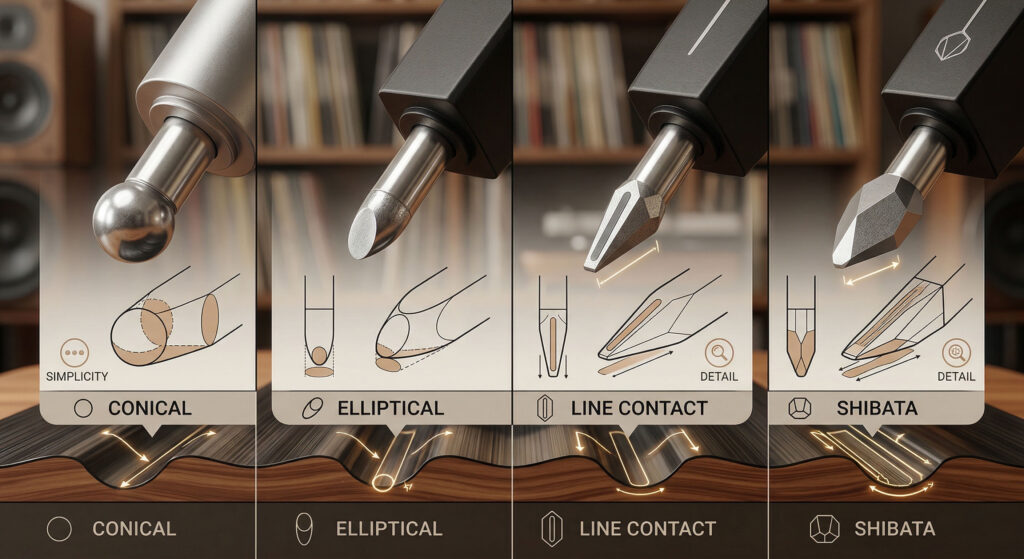
Conical (spherical) → Elliptical → Line Contact → Shibata / MicroLine. Each step up retrieves more groove detail, causes less record wear per play, and costs more. For most record player owners, elliptical is the sweet spot. Line contact and above reward serious systems with properly aligned tonearms.
The stylus tip is where music begins. Everything the cartridge hears — every detail, every nuance, every frequency — comes from this diamond point tracking through a groove that is thinner than a human hair. The shape of that tip determines how much of the groove wall it contacts, how accurately it tracks high-frequency modulations, and how much wear it causes with each pass.
Understanding stylus shapes is one of the most practical things a record player owner can learn — because upgrading from a conical to an elliptical stylus is one of the most cost-effective improvements you can make to any record player system, often for under $30.
Why Shape Matters — Groove Contact and What It Does
A vinyl groove has two walls angled at 45 degrees — left and right channels. The stylus tip rides between them, vibrating laterally as the groove modulations push it from side to side. The key variables are: how much of the groove wall the tip contacts, and how precisely it follows rapid changes in modulation.
The principle is simple: more groove contact = more detail retrieved = less pressure per square millimeter = less wear. A Shibata stylus spreads its contact over a far larger area than a conical — meaning lower pressure per point despite the same tracking force, which is why advanced stylus shapes cause less groove wear despite their greater precision.
Four Stylus Shapes — What Each One Actually Does
Budget / portable players
Conical styli are found on budget and portable record players. They are robust and forgiving of poor alignment — but they sacrifice detail retrieval and cause concentrated groove wear at their two small contact points.
Best value upgrade
Most record players
This is the standard on most quality record players — including the Arkrocket Rocket MM cartridge (AR-N60), which uses an elliptical diamond tip. It is the correct choice for the vast majority of record player owners: a meaningful improvement over conical without the alignment demands of advanced shapes.
High detail
Less wear
Serious listeners
Known under various trade names — Hyperelliptical, Fine Line, Stereohedron — all describe the same principle. The catch: the sharp edge demands more precise cartridge alignment. A misaligned line contact stylus does more damage than a well-aligned elliptical. On a properly set-up record player, the improvement is clearly audible.
Maximum detail
Lowest wear
Audiophile systems
A remarkable property: a Shibata can contact areas of the groove that were never touched by previous conical or elliptical styli — meaning it can retrieve pristine detail from a record that appears worn. MicroLine (Audio-Technica) and MicroRidge are related designs that approximate the shape of the original cutting stylus used to make master discs.
Where to Start — and When to Upgrade
If your record player came with a conical stylus — common on budget all-in-ones — upgrading to an elliptical replacement stylus is the single highest-return improvement available. The improvement in high-frequency detail, inner-groove tracking, and overall clarity is immediate and audible on any system. It typically costs $20–50 and takes 30 seconds to swap.
For Arkrocket record player owners: the factory AR-N60 cartridge already uses an elliptical diamond tip — which is exactly right for this class of record player. Upgrading to line contact or Shibata would require a compatible tonearm with precise azimuth adjustment to realize any benefit, and would be an over-investment for the system.
Advanced stylus shapes have a notable quirk: because their longer contact patch reaches areas of the groove wall not touched by simpler styli, they can retrieve more noise from a heavily worn or scratched record. A line contact stylus played on a record that was worn out by decades of conical styli may sound noisier than an elliptical on the same record. The information was damaged — the advanced stylus just reveals it more honestly. Clean records thoroughly before judging any new stylus.
Stylus shape is one of the more satisfying rabbit holes in vinyl — the physics are elegant and the differences are real. For the vast majority of record player owners, the practical conclusion is straightforward: elliptical is the right shape for quality listening at any moderate price point, and the Arkrocket AR-N60’s elliptical diamond tip is correctly matched to its tonearm and record player system. Upgrading within the elliptical category — replacing a worn stylus with a fresh one — consistently delivers more improvement than jumping to an advanced shape on an unoptimized system. Save line contact and Shibata for when you’ve built a system worthy of their alignment requirements.
Interested in the products mentioned? Shop Arkrocket directly:
Browse Arkrocket Record Players →