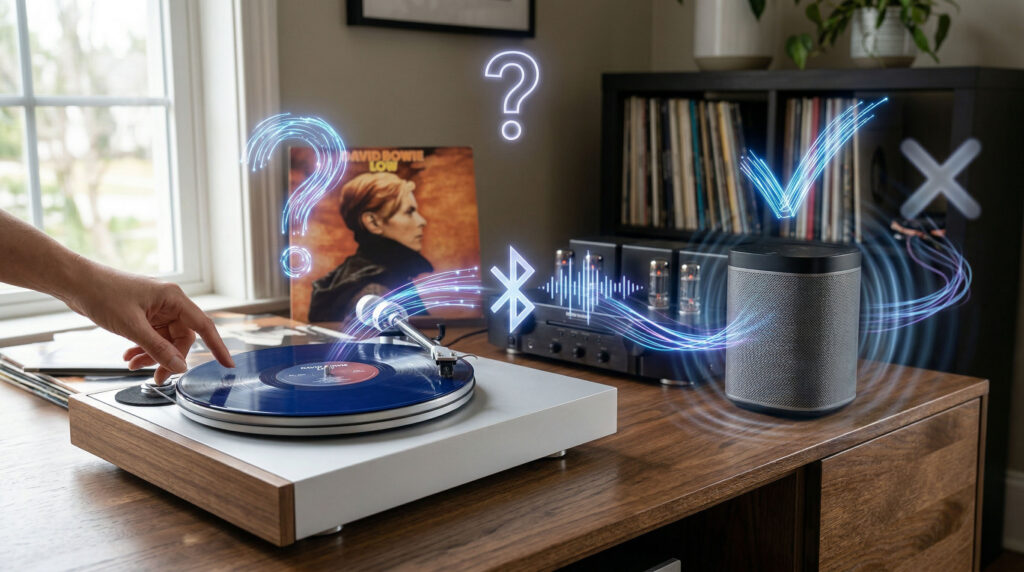
It depends on how you listen. A Bluetooth record player is worth buying if you want to connect to wireless speakers or headphones you already own, or if you want flexibility in where you place your speakers. It is not worth buying if pristine audio fidelity is your top priority — Bluetooth introduces audio compression that wired connections don’t. The good news: most Bluetooth record players also have wired RCA outputs, so you don’t have to choose one or the other.
Bluetooth is one of the fastest-growing features in vinyl hardware — and also one of the most misunderstood. Audiophile forums tend to dismiss it entirely. Beginner-oriented marketing tends to oversell it. The truth, as usual, sits in the middle.
This lesson explains exactly what Bluetooth does in a record player, where it genuinely helps, and when you’re better off with a wire.
What Bluetooth Does to Your Vinyl Signal
A vinyl record is an analog medium. The groove contains a continuous physical waveform. The stylus reads it and produces an analog electrical signal. Every step in the traditional chain — phono preamp, amplifier, speaker — keeps this signal in analog form.
Bluetooth doesn’t transmit analog signals. It transmits digital data. So for a record player to send music via Bluetooth, the analog signal must first be converted to digital, compressed into a Bluetooth codec, transmitted wirelessly, then decoded and converted back to analog at the speaker end. Each conversion step introduces a small amount of data loss.
Bluetooth signal path — analog → digital → analog
This compression is real — but how much it matters depends on the codec used and, frankly, on how critical your ears are. Most casual listeners cannot hear the difference in a blind test. Most dedicated audiophiles can, at high volumes through high-quality speakers.
Codecs — Why the Type of Bluetooth Matters
Bluetooth audio quality is largely determined by which codec the record player and speaker both support. SBC is the baseline — it compresses significantly. aptX and aptX HD compress far less and sound noticeably better. When shopping for a Bluetooth record player, check which codec it uses.
A record player with aptX HD will only transmit at aptX HD quality if the receiving speaker or headphones also support aptX HD. If the speaker only supports SBC, the connection defaults to SBC regardless of what the record player is capable of. Always check both ends of the Bluetooth chain before buying.
Bluetooth IN vs Bluetooth OUT — Know the Difference
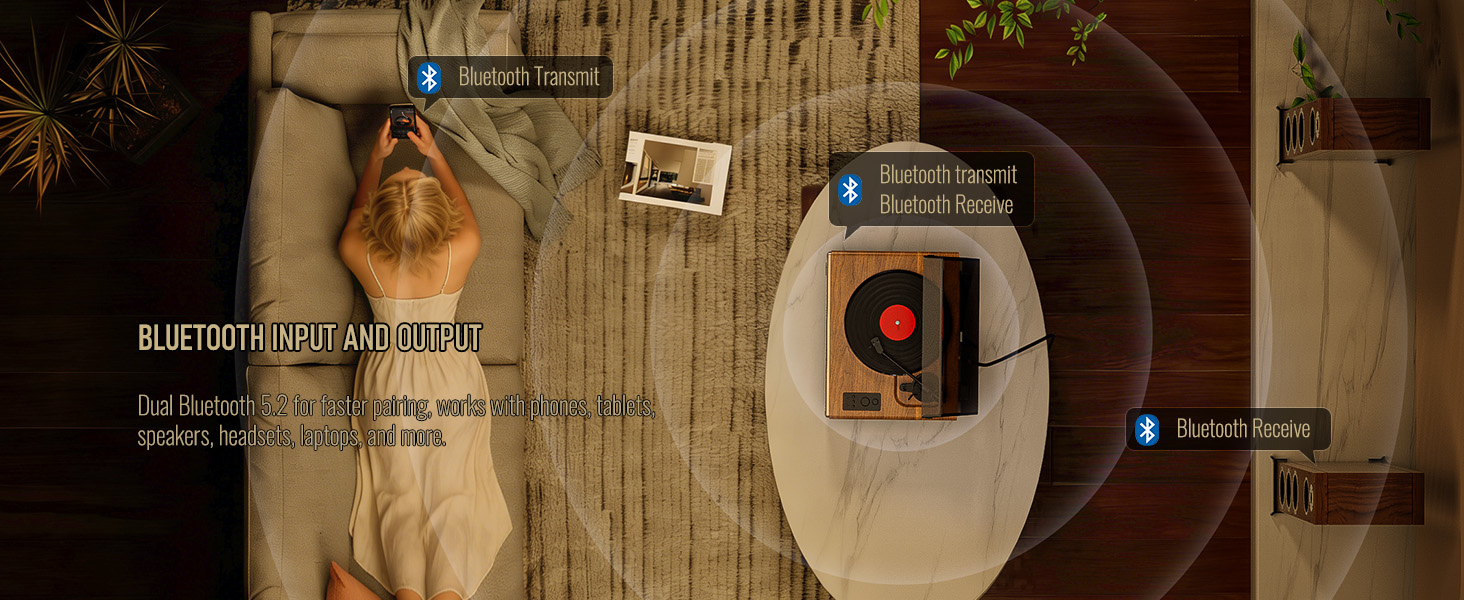
Many record players advertise “Bluetooth” without specifying direction. These are two completely different features that serve opposite purposes.
If you own an all-in-one record player with built-in speakers, Bluetooth IN lets you use those speakers for everyday music streaming — not just vinyl. This transforms the record player from a single-purpose device into your main room speaker system. The Arkrocket Huygens supports both Bluetooth IN and OUT for this reason.
When a Bluetooth Record Player Makes Sense — and When It Doesn’t
Can You Hear the Difference? The Honest Answer
Audiophile communities tend to describe Bluetooth as a catastrophic degradation of vinyl’s purity. This is overstated. The reality is more nuanced.
In controlled blind tests, most casual listeners cannot reliably identify Bluetooth audio vs wired audio through typical home speakers at normal listening volumes — especially with aptX or aptX HD. The gap narrows further when the record player itself uses modest components, because the limiting factor becomes the cartridge and phono preamp quality, not the transmission method.
The gap becomes audible in specific conditions: very high volume, through high-resolution speakers and amplification, with a trained ear. If you’re in that category, you already know it. For everyone else, Bluetooth convenience is a reasonable trade-off.
Some budget record players are Bluetooth OUT only — they have no wired RCA output. This locks you permanently into the Bluetooth signal path with no way to upgrade to a wired connection later. Always choose a record player that includes both Bluetooth and standard RCA outputs, so you keep the option to go wired when you want to.
Should You Buy a Bluetooth Record Player?
No → Continue to question 2.
No → Continue to question 3.
No, convenience matters equally → Bluetooth is fine. Make sure it has aptX and RCA outputs as backup.
Bluetooth in Arkrocket Record Players
Arkrocket approaches Bluetooth as an additive feature — not a replacement for wired connectivity. Every Bluetooth-equipped Arkrocket record player retains standard RCA outputs so you always have the option to go wired.
Both the Huygens and Cassini support Bluetooth IN and OUT simultaneously. Bluetooth OUT streams your vinyl wirelessly to any Bluetooth speaker or headphones. Bluetooth IN lets you use the record player’s speaker system for streaming from your phone when you’re not playing records. Standard RCA outputs are always available for wired connection to any external amplifier or powered speakers.
The Curiosity III and Discovery II support Bluetooth OUT — stream vinyl wirelessly to any Bluetooth speaker. Both also retain wired RCA outputs. Bluetooth IN is not supported on these models, as their built-in speaker systems are optimized for vinyl playback rather than general-purpose streaming.
A Bluetooth record player is worth buying for most beginners and casual listeners — particularly if you own Bluetooth speakers, want flexible speaker placement, or want to use your record player’s speakers for everyday streaming. The audio quality compromise is small with aptX, and imperceptible in typical listening conditions. The one non-negotiable: always choose a record player with both Bluetooth and wired RCA outputs. This keeps your options open as your setup evolves.
Interested in the products mentioned? Shop Arkrocket directly:
Browse Arkrocket Record Players →