How to Replace a Turntable Belt — Step-by-Step
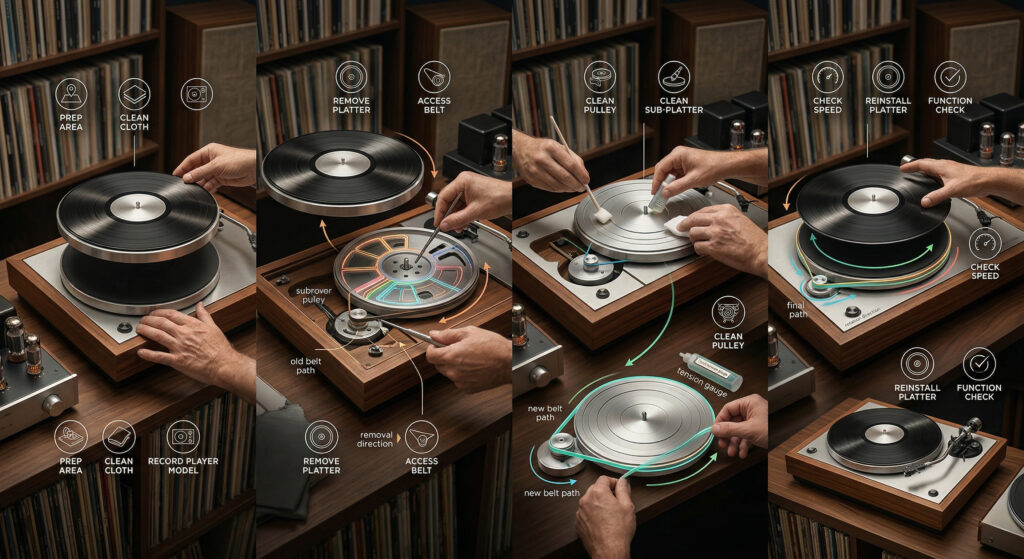
A turntable belt is a rubber loop that connects the motor to the platter. Over time it stretches, slips, or breaks — causing the platter to spin too slowly, inconsistently, or not at all. Replacing it is one of the simplest turntable repairs, typically taking under 10 minutes with no tools.
Signs Your Belt Needs Replacing
| Symptom | What It Means |
|---|---|
| Platter spinning noticeably slowly | Belt stretched — losing grip on the pulley |
| Music sounds flat or warbling | Belt slipping intermittently |
| Platter not spinning at all | Belt broken or completely off the pulley |
| Belt falls off when powering down | Belt too stretched — no longer holds tension |
| Speed varies between tracks | Belt worn, inconsistent grip |
Belts typically last 3–8 years depending on use. If you bought a second-hand turntable, replace the belt regardless — you don’t know its age.
What You Need
Replacement belt — must be the correct size for your model. Order from the manufacturer or search by model number. Arkrocket belts are available at arkrocket.com/parts. Third-party belts are available on Amazon by searching “[your model] turntable belt replacement.”
No other tools required for most belt-drive turntables.
Step-by-Step: Replacing the Belt
Step 1 — Power off and unplug the turntable
Always disconnect power before working on any part of the turntable. Move the tonearm to its rest position and engage the lock if there is one.
Step 2 — Remove the platter
Lift the platter straight up off the spindle. It should come away easily — most platters are simply resting on the centre spindle with no screws. Set it aside upside down on a soft surface.
You’ll now see the motor spindle (a small metal cylinder) exposed inside the plinth, and the belt drive groove on the underside of the platter rim.
Step 3 — Remove the old belt
Locate the old belt. It will either be sitting around the inner rim of the platter, around the motor spindle, or broken and lying loose inside. Remove it completely.
Step 4 — Loop the new belt around the platter
Stretch the new belt around the inner rim of the platter (the groove or lip on the underside). The belt should sit inside the groove without bunching. It will feel tight — this is correct.
Step 5 — Loop the belt onto the motor spindle
Hold the platter over the turntable in its normal position. Reach through the platter hole and loop the free side of the belt over the motor spindle. The motor spindle is the small cylinder visible through the access hole in the platter.
Tip: Use a pencil or pen to guide the belt onto the spindle through the access hole — easier than using your finger.
Step 6 — Place the platter back on the spindle
Lower the platter carefully onto the centre spindle, making sure the belt stays on the motor spindle as you do so. Spin the platter slowly by hand a few times to check the belt is seated correctly and not twisted.
Step 7 — Test
Power on the turntable and set it to 33 RPM. The platter should reach full speed within a few seconds and maintain it consistently. If it’s still slow, check that the belt is seated correctly on both the platter groove and the motor spindle.
Watch: Belt Replacement Walkthrough
Frequently Asked Questions
Can I shrink a stretched belt instead of replacing it?
Yes, for mild stretching only. Soak the belt in near-boiling water for 5–8 minutes. The heat causes the rubber to contract slightly. This can restore grip temporarily but won’t last as long as a new belt. If the belt is visibly cracked or broken, replace it.
How often should I replace the belt?
Every 3–5 years for regular users, or when any of the symptoms above appear. If the turntable sits unused for long periods, check the belt before returning to use — rubber degrades with age even without use.
Does the belt affect sound quality?
Yes. A worn belt causes speed instability, which manifests as pitch variation — a wavering or warbling quality on sustained notes, especially piano and strings. A fresh belt restores speed accuracy and noticeably improves the sound on these passages.
My turntable has two speed positions on the motor — which one do I use?
Some turntables (including the Arkrocket Discovery II) change speed by moving the belt between two positions on the motor pulley — a smaller diameter for 45 RPM and a larger diameter for 33 RPM. When you change speed, you need to physically move the belt. Check your manual for the specific positions.
See also: Why Is My Record Skipping? · How to Set Tracking Force · Vinyl 101 Free Course
← Back to Fix & Setup