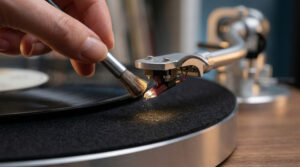
How to Level a Turntable

An unlevel turntable is one of the most overlooked causes of skipping, inner-groove distortion, and premature stylus wear. Even a small tilt — invisible to the naked eye — creates enough of an imbalance for the tonearm to drift inward or outward across the record rather than tracking straight. This guide shows how to check and correct it.
Why Levelling Matters
| Problem | How Unlevel Surface Causes It |
|---|---|
| Record skipping | Tonearm drifts sideways, pulling stylus from groove |
| Inner groove distortion | Anti-skate imbalance worsens on tilted surface |
| Uneven stylus wear | Stylus pressing harder on one groove wall |
| Tonearm not returning correctly | Gravity bias causes tonearm to swing off-axis |
| Speed instability | Bearing friction increases when platter is tilted |
What You Need
Spirit level — A small bubble level (~$5 at any hardware store). Alternatively, use a free spirit level app on your smartphone — these are accurate enough for turntable levelling.
Some turntables have adjustable feet. Others don’t — in which case you’ll need to level the surface the turntable sits on.
Step-by-Step: Levelling Your Turntable
Step 1 — Check the current level
Remove the dust cover. Place your spirit level on the platter (not the lid or the plinth — the platter is what matters). Check in two directions: front-to-back and left-to-right. The bubble should be centred in both orientations.
Step 2 — Identify which direction is off
Note which direction the bubble drifts. If it drifts to the left, the left side is lower. If it drifts toward you, the front is lower. You can be off in both axes simultaneously.
Step 3A — If your turntable has adjustable feet
Most quality turntables have rubber feet with threaded inserts that can be raised or lowered. Turn the foot clockwise to lower that corner, counterclockwise to raise it. Make small adjustments and recheck the level after each change. Work on one axis at a time — fix front-to-back first, then left-to-right.
Step 3B — If your turntable has fixed feet
You’ll need to level the surface instead. Check the shelf or cabinet the turntable sits on with the spirit level. If the furniture is off, use thin shims (folded card, rubber pads, or furniture levellers) under the low corner of the shelf until the surface is level.
If your shelf itself is level but the turntable still isn’t (some turntable bases are slightly uneven from the factory), place thin shims directly under the turntable feet on the low side.
Step 4 — Verify
Once level, play a record and listen for any tonearm drift or skipping. A correctly levelled turntable will track smoothly from the outer groove to the inner label without the tonearm visibly pulling in either direction.
Watch: How to Level a Turntable
Best Surfaces for a Turntable
Ideal: A solid, heavy, non-resonant shelf — stone, thick MDF, or a wall-mounted shelf on a solid wall. Heavy furniture with minimal flex. Dedicated audio rack like the Arkrocket Statio rack, which is designed for correct turntable height and isolation.
Avoid: Hollow wooden floors with flex, thin particleboard shelves that vibrate, surfaces near speakers that conduct vibration, and any surface that wobbles when weight is applied.
FAQ
How level is level enough?
The bubble should be centred, not just close. A 1–2 degree tilt is enough to cause problems on a sensitive tonearm. With a spirit level app, aim for 0.0° to 0.5° in both axes.
My shelf is slightly off — does the whole shelf need to be level or just the turntable?
The platter needs to be level — how you achieve that is flexible. Shimming under the turntable feet is often easier than adjusting the shelf, and equally effective.
See also: Why Is My Record Skipping? · How to Set Tracking Force · Vinyl 101 Free Course
← Back to Fix & Setup