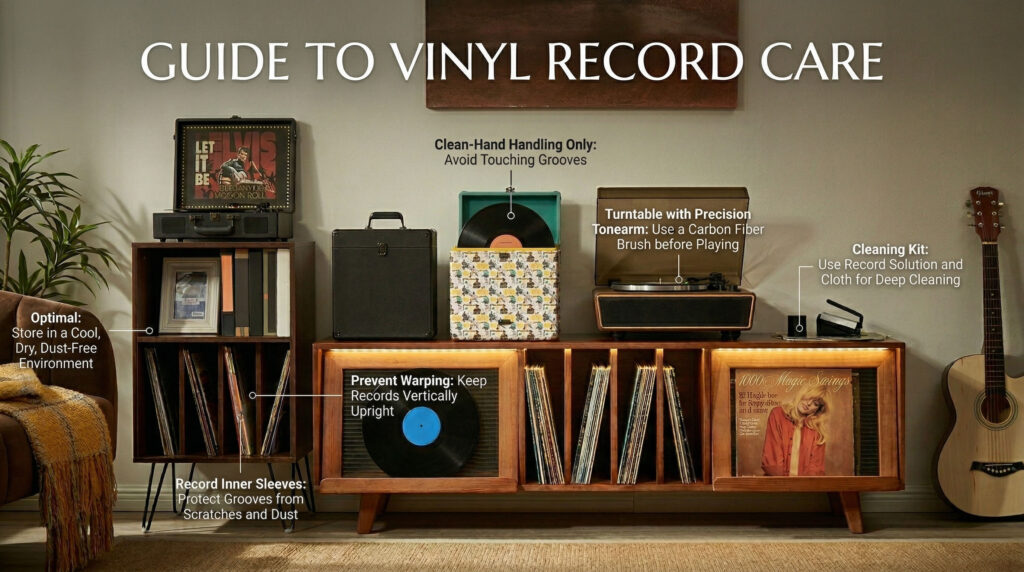
Vinyl 101 · Unit 2 · Lesson 2.3
The three rules that protect 90% of collections
Handle by edges only — never touch the playing surface. Store vertically — never flat or leaning. Keep inner sleeves — the paper sleeve between the record and the jacket is not decoration. Follow these three rules and your records will last for decades. Ignore them and even a $50 record can be ruined in months.
Vinyl records are more durable than their reputation suggests — a well-pressed record can be played hundreds of times without audible deterioration. But they are also unforgiving of specific mistakes: fingerprint oils, horizontal stacking, heat, and humidity can each cause permanent damage that no cleaning will fix. This lesson covers exactly what to do and what to avoid.
When you pick up a record
How to Handle Vinyl Records — The Fundamentals
Every time you touch a vinyl record’s playing surface, you deposit skin oils into the microscopic grooves. Those oils attract and trap dust. Dust in the grooves causes crackling, pops, and surface noise during playback. Repeated contamination builds up over time and eventually becomes audible even after cleaning.
The playing surface is the area between the label and the outer edge. This zone should never be touched with bare fingers.
✓
Hold by the outer edge and the label
Place your thumb on the outer edge and your fingers under the label at the center. This keeps both hands clear of the playing surface at all times. Use both hands for better control when removing records from sleeves.
✓
Wash and dry your hands before handling
Clean, dry hands transfer far fewer oils than hands that have been touching food, your face, or other surfaces. This takes 30 seconds and makes a measurable difference to long-term record condition.
✓
Slide the record out horizontally, not vertically
When removing a record from its sleeve, tip the sleeve sideways and let the record slide out. Pulling it straight up through the sleeve opening creates friction that can drag the sleeve paper across the playing surface — causing fine scratches.
✗
Never touch the playing surface — ever
Even a single fingerprint leaves oils that attract dust. If you accidentally touch the surface, clean the record before playing it. Over time, repeated fingerprint contamination becomes permanent surface noise.
✗
Never set a record down groove-side on any surface
Even a seemingly clean table will scratch the playing surface. If you need to set a record down momentarily, place it label-side down on a clean, soft surface — or better, hold it properly until you’re ready to put it back in the sleeve.
✗
Never drop a record into its sleeve
The impact and sliding motion of dropping a record in vertically drags the sleeve’s interior surface across the grooves. Always lower it in carefully at an angle, then straighten.
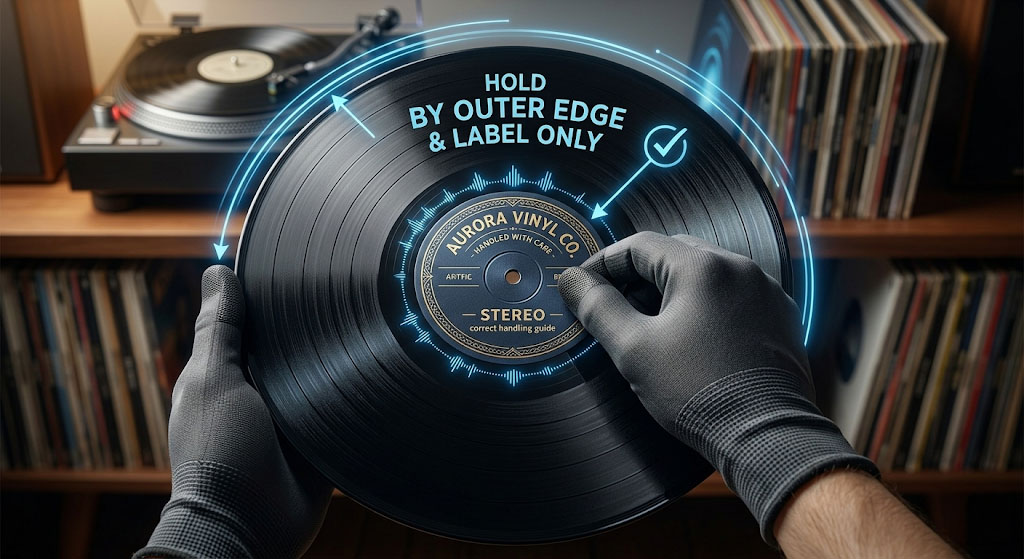
The correct grip: thumb on the outer edge, fingers under the center label. The playing surface — the grooved area between the label and the rim — never contacts bare skin. This habit protects every record you’ll ever own.
The single most important storage rule
Store Vertically — Always
Vinyl is a thermoplastic material. It responds to pressure over time. When records are stored flat and stacked, the weight of the records above presses down on the records below. Over weeks and months, this causes the lower records to warp — developing a dish shape or wave that makes playback difficult and sometimes impossible.
✓ Vertical — correct
Weight distributed evenly through the record’s edge. No pressure on playing surface. Easy to browse and retrieve.
✗ Horizontal — causes warping
Weight presses down on records below. Leads to warping over weeks. Makes retrieval difficult and increases handling damage.
Leaning is just as dangerous as flat stacking
Records stored vertically but leaning at an angle — because the shelf is too wide, or because the collection is too small to fill the space — will gradually warp along the lean axis. Records must stand perfectly upright, supported on both sides. If your shelf has too much space, fill the gap with a record divider, a few magazines, or even a folded towel — anything that keeps the records standing straight.
The IKEA Kallax shelf — the vinyl collector’s standard
The IKEA Kallax (and its predecessor, the Expedit) has become the default record storage shelf among collectors worldwide. Each cube is almost exactly the right depth and height for 12-inch LPs stored vertically. A single 2×2 Kallax holds approximately 80–100 LPs. The 4×4 version holds 320–400. Inexpensive, widely available, and purpose-built for vinyl by accident.
Protection layers
Inner Sleeves, Outer Sleeves — What You Actually Need
A vinyl record in its jacket has two layers of protection: the inner sleeve (the paper or poly envelope the record slides into directly) and the outer sleeve (the cardboard or paper jacket itself, which often has artwork). Both matter, and the default inner sleeves that come with most records are often the weakest link.
Best
Polyethylene (PE) or polypropylene (PP) inner sleeve
The upgrade worth making for any record you care about. Smooth, anti-static plastic that lets the record slide in and out without friction. Does not shed paper fibres into the grooves. Reduces static buildup. Costs approximately $0.30–0.50 per sleeve. Replace original paper sleeves with these on any record you play regularly.
Acceptable
Paper/poly lined inner sleeve
A paper outer with a smooth poly interior lining. Stiffer than plain poly, which some prefer — easier to handle. The poly lining prevents paper fibres from touching the record surface. A good compromise between cost and protection.
Replace
Original plain paper inner sleeve
Most new records ship with a basic paper inner sleeve. Paper fibres can scratch the record surface as it slides in and out. Paper is also slightly acidic over time. Replace these with poly sleeves for records you value or play regularly. Original paper sleeves can be kept for archival reference but shouldn’t be in contact with the record surface.
Never use
PVC (polyvinyl chloride) outer sleeves
PVC sleeves emit gases that react with vinyl over time, causing surface damage and potential groove degradation. Despite being common and cheap, PVC should never be used for long-term storage of vinyl records. Use polypropylene outer sleeves instead — they are optically clear, inert, and safe for long-term storage.
Where to store your collection
Temperature, Humidity and Light — The Environmental Enemies
Vinyl is stable and long-lasting under the right conditions. The same record can sound identical after 50 years of proper storage. The wrong environment can warp, discolor, or grow mold on a record in a matter of months.
Temperature
✓ 65–70°F (18–21°C) — cool and stable
✗ Above 80°F / 27°C — warping risk
Humidity
✓ 40–50% relative humidity
✗ Above 60% — mold risk; below 30% — static
Light
✓ Dark or indirect light — cool and dim
✗ Direct sunlight — heat warping, UV fading
Location
✓ Interior wall, away from vents and windows
✗ Attic, garage, car — extreme temperature swings
Vibration
✓ Away from speakers when not playing
✗ Next to subwoofer, washing machine
Never leave records in a car
A car interior on a warm day can reach 130°F / 54°C within minutes. Vinyl softens at around 140°F / 60°C and will warp permanently if left in direct sunlight in a parked car even for 20–30 minutes. This is the most common cause of catastrophic record damage. Transport records in a bag, keep them out of direct sun, and never leave them in a parked car.
At the turntable
Before and After Every Play — A Simple Routine
The moment of playback is when records are most vulnerable — the stylus is in direct contact with the groove, and any dust or debris present will be dragged through it by the needle. A brief cleaning routine before each play is the single most effective thing you can do to extend your records’ lifespan.
1Before playing: brush the record with a carbon fibre anti-static brush. Sweep around the groove direction (circular, following the spiral) two or three times. This lifts surface dust and dissipates static charge that attracts more dust.
2Clean the stylus: use a dry stylus brush (front to back, never side to side) to remove any debris from the stylus tip before it contacts the record. A contaminated stylus drags dirt through the groove and can scratch it.
3After playing: brush again before returning to sleeve. Do not blow on the record — your breath introduces moisture and microscopic debris.
4Return immediately to inner sleeve, then outer jacket. Do not leave records on the platter between plays or sessions.
The one accessory every record player owner needs
A carbon fibre anti-static record brush costs $10–20 and is the most cost-effective accessory in vinyl. Used before every play, it removes surface dust, reduces static, and protects both the record and the stylus from the gradual accumulation of debris that causes pops, clicks, and audible wear. Keep one on your record player shelf at all times.
From Arkrocket
Storage Solutions We Recommend
Proper storage starts with the right furniture. Arkrocket’s accessories are designed to work alongside their record players — keeping your collection vertical, protected, and looking good.
Record Storage
Artemis Records Storage Case — Flora Engraved
A handcrafted wood storage case with intricate flora engraving, designed to hold LP records vertically in perfect archival position. Built for collectors who want their collection displayed as beautifully as it sounds. The interior keeps records standing straight — eliminating the lean-warping problem entirely.
View Product →
Limited Edition Storage
Arkrocket × Elvis Records Storage Case — Elvis Presley ’68
A limited edition collaboration storage case featuring the iconic Elvis ’68 Comeback Special aesthetic. Combines serious record protection with collectible design — the record case as a statement piece. Stores LPs vertically in a dedicated interior structure, with the added appeal of a piece of music history on the outside.
View Product →
Audio Furniture
Statio Audio Rack — Dart Walnut
A purpose-built audio rack in Dart Walnut finish, designed to hold your record player at the correct listening height while keeping your collection vertically stored beneath it. Solves the shelf-depth problem that most generic furniture creates for vinyl setups — built to the exact proportions that LP storage requires, with a stable platform for the turntable above.
View Product →
RecordPlayerLab verdict
Vinyl record care is not complicated — it is consistent. Handle by edges only, store perfectly vertical, upgrade inner sleeves from paper to poly, keep away from heat and direct light, and brush before every play. These habits cost almost nothing and take seconds. A record collection treated this way will sound as good in 30 years as it does today. A collection stored carelessly will begin showing audible deterioration within months.
← Previous
Lesson 2.2 — Vinyl record sizes and speeds
Next →
Lesson 2.4 — Setting up your first record player
vinyl 101
how to store vinyl records
vinyl record care
record storage
inner sleeves
vinyl handling
record player care
anti-static brush
vinyl warping
beginner guide
Interested in the products mentioned? Shop Arkrocket directly:
Browse Arkrocket Record Players →