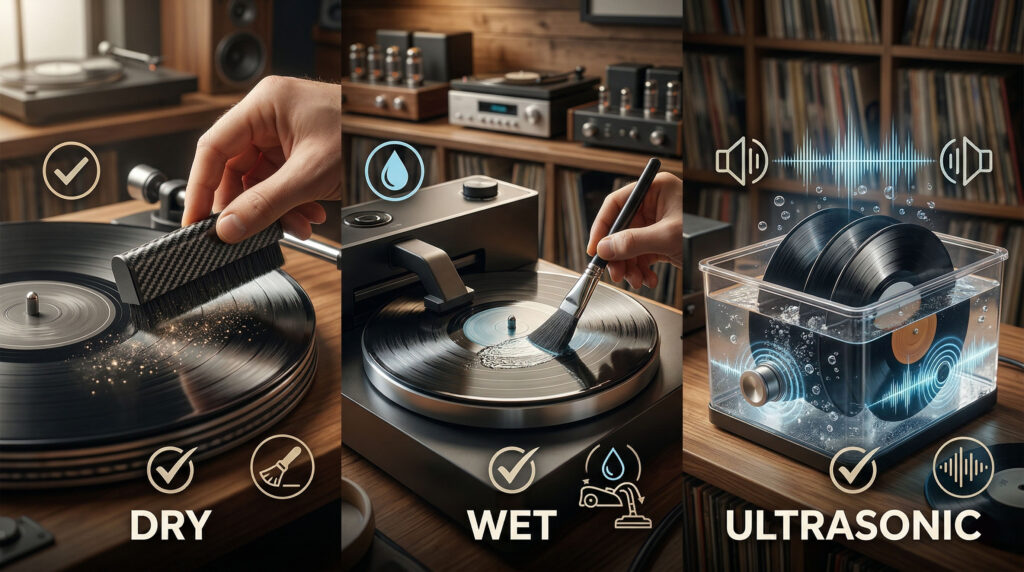
Dry brush — before every single play. Takes 10 seconds. Removes loose dust and static. The minimum every record player owner should do.
Wet clean — whenever a record sounds worse than it should, or before playing any used record. Takes 5 minutes. Removes embedded grime, oils, and pressing residue.
Ultrasonic clean — for seriously dirty, valuable, or neglected records. Takes 20–30 minutes. Reaches contamination that wet cleaning cannot.
Cleaning records isn’t optional — it’s maintenance. Every play deposits microscopic debris from the stylus into the groove. Every time you remove a record from its sleeve, static attracts fresh dust. A record that sounds great today will sound progressively worse without regular cleaning — not because the record is wearing out, but because it’s getting dirtier.
The good news: most cleaning takes seconds. The great news: a seriously degraded record that sounds unplayable can often be completely transformed with a thorough wet clean. Understanding which method to reach for — and when — makes all the difference for your Arkrocket record player and your collection.
Dry Brushing — The 10-Second Rule Before Every Play
Removes: surface dust + static
Frequency: every play
Hold the record on the platter or by its label — never touch the playing surface.
Place the brush gently across the record surface. Let the bristles sink into the grooves — don’t press hard.
Rotate the record slowly (or hold the brush while the platter spins on your Arkrocket record player) for two to three full revolutions.
Sweep the brush off the edge of the record — taking the lifted dust with it — rather than lifting it straight up.
Repeat after playing before returning to the sleeve.
Over time, your carbon fibre brush accumulates the dust it lifts from records. A clogged brush is less effective and can redistribute debris rather than removing it. Clean it by gently dragging a fine-toothed comb or another brush across the bristles to lift out trapped particles. Do this every 20–30 plays or when you notice the brush feels less effective.
Wet Cleaning — For Embedded Grime That Brushing Can’t Remove
Removes: oils, grime, pressing residue
As needed
Dry brush first to remove loose surface dust before applying liquid.
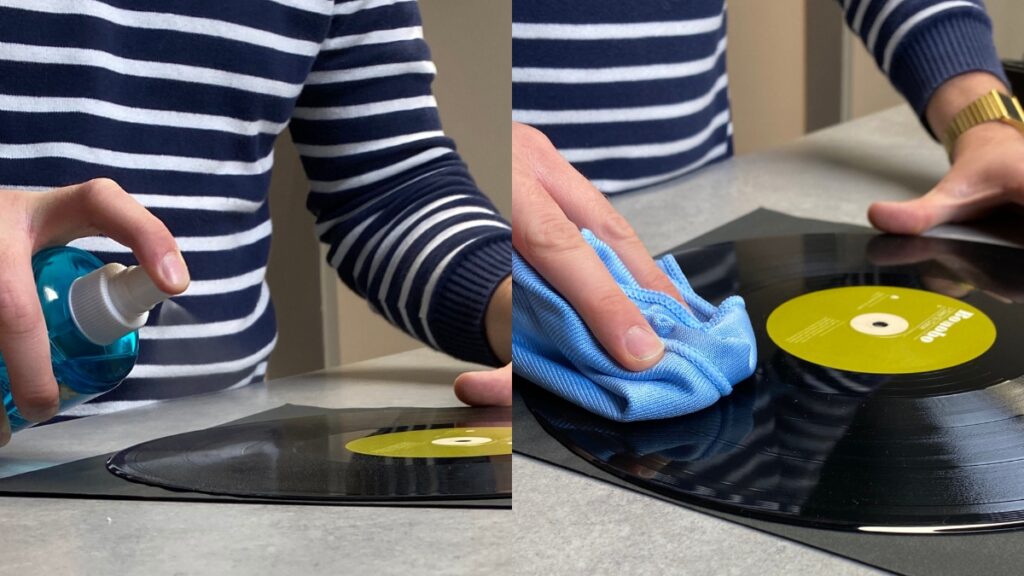
Apply a small amount of vinyl cleaning solution to a dedicated microfibre cloth or velvet cleaning pad — never directly onto the record.
Hold the record by its label and outer edge. Work the cloth in a circular motion following the groove direction — never back and forth across the grooves.
If using a rinse step, wipe with distilled water on a clean cloth to remove solution residue.
Stand the record vertically in a drying rack and allow to air dry completely — minimum 20 minutes — before playing on your record player.
Tap water contains dissolved minerals — calcium, magnesium, chlorine — that deposit in the groove as the water evaporates. These deposits cause crackling noise that is almost indistinguishable from dirt. Always use distilled water for wet cleaning and rinsing. It costs about $1 per gallon and the difference is significant. Similarly, never use household cleaners, glass cleaners, or rubbing alcohol — they contain additives that damage vinyl and leave residue.
Ultrasonic Cleaning — The Best Method Money Can Buy
Removes: everything wet cleaning can’t
Occasional / specialist
The result is audibly dramatic on dirty records. Background noise drops significantly. Surface detail and high-frequency clarity return. Records that seemed permanently damaged often sound almost new. Popular consumer options include the HumminGuru and Degritter, both designed specifically for vinyl.
Fill the tank with distilled water and a few drops of a vinyl-safe surfactant solution.
Pre-brush the record to remove loose surface debris before the bath.
Place records on the spindle system — most machines rotate records slowly through the bath over 10–20 minutes.
Rinse with clean distilled water after the cycle.
Dry completely — most machines include a drying function, or stand vertically in a rack for 30+ minutes before playing on your Arkrocket record player.
What to Use — and What to Never Put Near a Record
Stylus Cleaning — The Step Most Record Player Owners Skip
Cleaning the record without cleaning the stylus is like washing your dishes with a dirty sponge. The stylus on your Arkrocket record player accumulates the same debris it removes from the groove — and replays it into subsequent records, spreading contamination through your collection.
Dry stylus brush — sweep front to back (in the direction the record travels) with a dedicated soft-bristle stylus brush. Never side to side — lateral force can snap the cantilever. This takes three seconds and removes the majority of debris.
Gel cleaner (Onzow Zerodust or equivalent) — lower the stylus gently onto the gel pad and lift. The gel adheres to and removes debris without any mechanical force. Ideal for stuck-on contamination that the brush misses. Use occasionally — not every play.
Never use alcohol on the stylus — it dissolves the adhesive bonding the stylus tip to the cantilever, causing premature failure. The stylus on your Arkrocket record player is precision-bonded — keep it that way.
Clean New Records Before First Play — Always
This surprises almost everyone the first time they hear it. A brand new, sealed record player album can crackle noticeably on first play — not because it’s defective, but because the pressing process leaves mold release compound residue in the grooves. This invisible film is water-soluble and comes off completely with a wet clean.
Experienced Arkrocket record player owners and collectors report that wet cleaning new records before first play consistently improves the listening experience — sometimes dramatically. Records that seemed mediocre reveal themselves as excellent pressings once the factory residue is removed. Make it a ritual: new record arrives, wet clean before it ever touches the stylus.
Get the Right Brush for Your Record Player
The Arkrocket Vinyl Record Cleaning Brush is the simplest upgrade you can make to your record player setup — and the one that protects your collection with every single play.
Cleaning vinyl records is the highest-return maintenance activity for any record player owner. A carbon fibre anti-static brush used before every play, combined with wet cleaning whenever a record sounds worse than it should, keeps a collection sounding excellent indefinitely. For used or thrift-store records, a wet clean before first play is non-negotiable — you have no idea what the previous owner’s stylus did to the groove, and cleaning costs five minutes while the alternative is accelerating that damage on your own Arkrocket record player. The investment in good cleaning tools is trivial compared to the records they protect.
Interested in the products mentioned? Shop Arkrocket directly:
Browse Arkrocket Record Players →