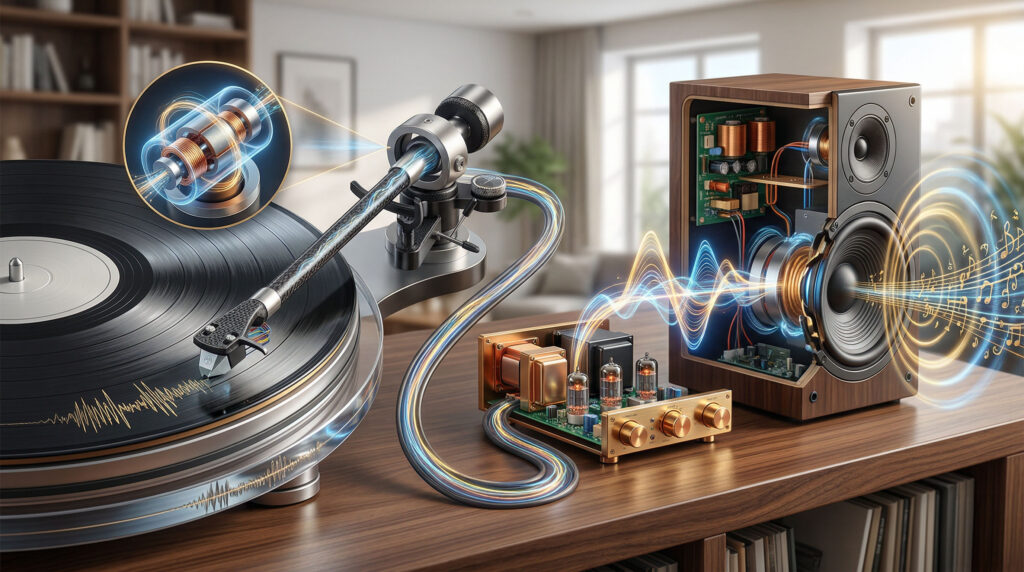
A record player works by dragging a diamond-tipped stylus through a physical groove carved into vinyl, converting the groove’s tiny vibrations into an electrical signal, amplifying that signal, and sending it to speakers. No digital processing, no software — just physics turning movement into music.
A needle dragging through a plastic groove probably shouldn’t be able to produce a full orchestra. And yet it does — with a clarity and warmth that millions of listeners still prefer over any digital format. Understanding how a record player actually works makes you a better listener, a smarter buyer, and someone who can diagnose problems when they appear.
The full journey from groove to speaker involves five steps. Each one is simple on its own. Together, they’re quietly remarkable.
From Groove to Speaker — Five Steps
groove vibration
→
millivolt signal
→
line level
→
speaker cone
→
air pressure waves
The Parts of a Record Player — What Each One Does
The Groove — How Sound Is Physically Encoded in Plastic
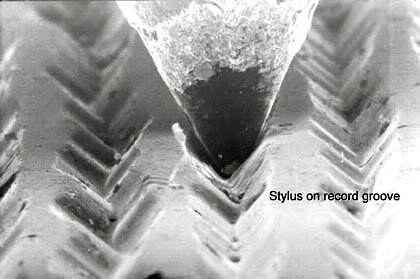
The most remarkable thing about a vinyl record isn’t the player that reads it — it’s the record itself. A standard LP has a single continuous groove that spirals from the outer edge to the inner label over roughly 1,500 feet of total length. The groove is approximately 0.04mm wide — about half the width of a human hair.
Inside that groove, the walls are not straight. They contain microscopic lateral and vertical undulations — the physical representation of the sound waveform. When the original music was recorded, a cutting lathe drove a heated stylus through a lacquer disc, carving groove shapes that exactly corresponded to the audio signal. Every cymbal crash, bass note, and vocal nuance is encoded as a specific shape in the groove wall.
A stereo record encodes two channels in a single groove using the 45/45 system. The left channel is encoded in the inner groove wall at a 45° angle; the right channel in the outer groove wall at 45°. The stylus reads both walls simultaneously, and the cartridge separates the signals. This is why tilting or misaligning the cartridge affects channel balance — a perfectly aligned stylus reads both walls equally.
Why Vinyl Sounds Different from Digital
This is a topic that fills books and fuels arguments. The brief, honest explanation:
Digital audio captures sound by sampling it at a fixed rate (44,100 times per second for CD quality). Each sample is a number. The resulting audio is mathematically precise — but it is a series of discrete measurements, not a continuous wave.
Analog audio — vinyl — is a continuous physical waveform. The groove wall’s shape is a direct physical analogue of the original air pressure wave. There are no samples, no quantization steps, no digital processing. The stylus reads an exact physical copy of the original sound, limited only by the quality of the cutting and playback equipment.
The characteristic warmth and richness often associated with vinyl is partly the result of harmonic distortion — small amounts of even-order harmonic content introduced by the cartridge and analog circuitry. Human hearing tends to find even-order harmonics pleasing rather than grating. Digital formats have different distortion characteristics. Neither is objectively more “accurate” — they are different, and many listeners have a genuine preference for one over the other.
Why Understanding the Chain Makes You a Better Buyer
Every step in the signal chain affects the final sound. Knowing the chain helps you identify where to invest and where problems come from:
1. Cartridge and stylus — the first point of contact with the record. Stylus shape, tip quality, and tracking force affect both sound quality and record wear more than any other single component.
2. Phono preamp — a poor phono preamp introduces noise and RIAA inaccuracy that colors everything downstream. An upgrade from a budget built-in to a $40–$80 external preamp is often the most cost-effective improvement.
3. Tonearm quality — bearing friction and arm mass affect how accurately the stylus tracks the groove, especially in complex passages and near the inner grooves.
4. Platter and motor stability — wow and flutter (speed instability) cause pitch wavering that is immediately audible on sustained notes and piano.
5. Plinth isolation — external vibrations reaching the stylus create rumble and can cause acoustic feedback at high volumes.
This hierarchy explains why a $299 record player with a quality MM cartridge and a solid plinth often outperforms a $500 record player with a poor cartridge. The cartridge is the conversion point — everything before it (motor, platter, tonearm) determines how accurately it reads the groove, and everything after it (preamp, amplifier, speakers) determines how well that reading is reproduced.
A record player is a precision mechanical instrument that converts the physical shape of a groove into music through a chain of energy transformations — mechanical to electrical to acoustic. Every component in that chain matters, and understanding what each one does makes every future purchase decision clearer. The stylus is where music begins. Everything else either preserves or compromises what the stylus finds in the groove.
Interested in the products mentioned? Shop Arkrocket directly:
Browse Arkrocket Record Players →