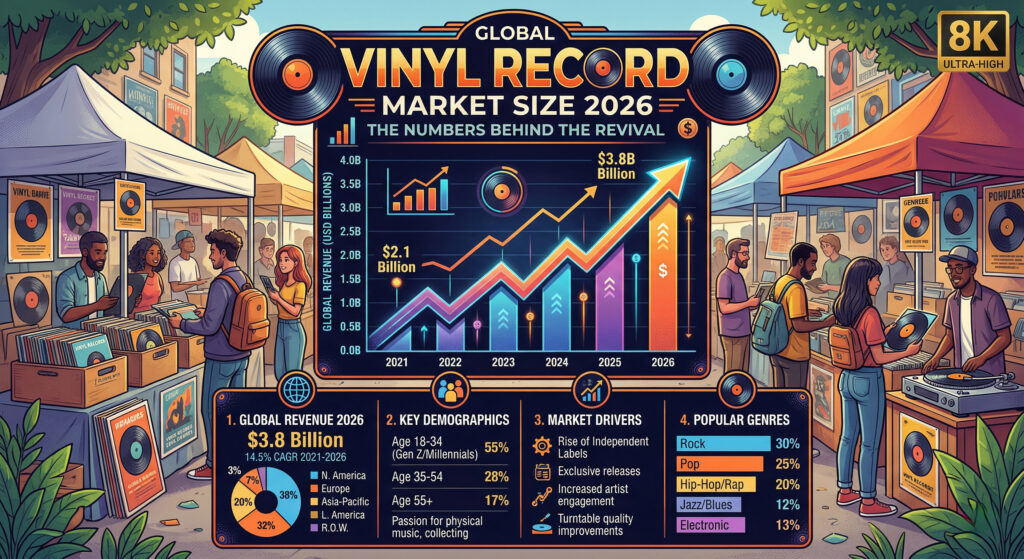
The record player hardware market is growing independently of — but in parallel with — the vinyl records market it serves. As of 2025, the global vinyl record player market was valued at $560 million, with projections pointing to $960 million by 2035. This report covers the key trends, regional dynamics, and technology shifts shaping the category in 2026.
Market Size & Growth Forecast
| Year | Market Value | Notes |
|---|---|---|
| 2024 | ~$530 million | Pre-growth baseline |
| 2025 | $560 million | Actual |
| 2026 | $600 million | Projected |
| 2030 | ~$750 million | Projected at 6.5% CAGR |
| 2035 | $960 million | Projected |
Source: Business Research Insights, Vinyl Record Players Market Report 2026–2035. CAGR of 6.5% reflects sustained demand from both new buyers and upgrade purchasers replacing entry-level players with more capable systems.
Key Market Drivers in 2026
1. Vinyl Record Sales Create Direct Hardware Demand
The relationship between record sales and player hardware demand is direct but not proportional. In 2025, 47.9 million vinyl units were sold in the U.S. alone — but 58% of buyers were aged 18–34, a demographic that skews toward first-time purchases rather than replacements. This creates a sustained pipeline of new hardware buyers entering the market each year, as first-time vinyl listeners need a first record player.
2. The Upgrade Cycle
Entry-level record players (sub-$150) have been the dominant category since the vinyl revival began around 2006. Buyers who started with a Crosley or basic suitcase player ten to fifteen years ago are now actively upgrading to proper belt-drive systems with moving magnet cartridges, built-in phono preamps, and Bluetooth connectivity. This upgrade cycle is a structural tailwind for mid-range systems in the $200–$400 price bracket — the most competitive segment in the market today.
3. Bluetooth Integration Has Become Table Stakes
In 2019, Bluetooth on a record player was a differentiating feature. In 2026, it’s a baseline expectation. More significantly, buyers are now distinguishing between Bluetooth output only (stream vinyl to wireless speakers) and full Bluetooth in/out (also stream from phone to the player’s speakers). Systems like the Arkrocket Cassini that offer both paths are winning the mid-market on this feature alone.
4. All-in-One Systems vs. Separates
The market has bifurcated clearly. Buyers who want maximum convenience are choosing all-in-one systems with built-in speakers — units like the Arkrocket Huygens, with 30W four-speaker output and triple shock-absorption to prevent feedback. Buyers who want room-filling sound are choosing separate bookshelf speaker systems. The $250–$400 price range now offers genuine options in both categories.
Regional Market Analysis
Asia-Pacific: The Largest Regional Market
Asia-Pacific has emerged as the dominant regional market for vinyl record players by revenue. Japan is the anchor — Tower Records and Disk Union anchor a sophisticated collector market, and Sony’s decision to reopen its vinyl pressing plant in Japan in 2017 was a signal to the hardware market that the format had serious long-term legs. South Korea’s K-pop fanbase drives significant volume: BTS and Blackpink vinyl releases create corresponding hardware purchase cycles among fans who need players for the records they’re buying.
North America: The Premium Segment Leader
North America leads in premium hardware revenue. The U.S. market’s 19-year growth streak in vinyl sales has created a deep installed base of hardware buyers, and the upgrade cycle is accelerating as early buyers of cheap entry-level players look for something better. The $300–$500 segment is the most contested, with brands like Arkrocket, Audio-Technica, Pro-Ject, and Rega competing for buyers who know enough to want quality but aren’t yet committed to audiophile-tier spending.
Europe: Design-Conscious Buyers
European buyers skew toward design-forward hardware. Pro-Ject (Austria) and Rega (UK) dominate the audiophile segment, with strong brand loyalty built on decades of craftsmanship reputation. The mid-market is more competitive, with Asian and American brands gaining ground on the strength of feature sets — Bluetooth, built-in phono preamps, and aesthetic versatility — that European specialty brands have historically deprioritized.
Technology Trends for 2026
Iron and Alloy Platters Replacing Plastic
Entry-level record players have long used lightweight plastic platters that introduce speed instability and audible wow and flutter. The mid-market shift toward iron and alloy platters — as seen on the Arkrocket Cassini — is the most significant performance upgrade available at the $300–$350 price point. More rotational mass means better speed consistency, which means better pitch accuracy on sustained musical notes.
Moving Magnet Cartridges as Standard
The industry has largely eliminated ceramic cartridges from the mid-market. Moving magnet cartridges — like the AR-N60 used across the Arkrocket Premier lineup — track grooves more accurately, produce less distortion, and cause significantly less stylus wear to records. This is a meaningful shift for the long-term health of vinyl collections.
Shock Isolation Engineering
The feedback problem in all-in-one players — where speaker vibration affects the stylus — was considered an inherent limitation of the format for decades. Modern engineering approaches, including the triple shock-absorption system in the Huygens, are changing that. Isolating the playback mechanism from speaker vibration allows all-in-one systems to operate at higher volumes without sonic degradation.
Competitive Landscape
The mid-market record player segment ($200–$500) is the most competitive price range in the industry, contested across several distinct brand categories:
Mass-market brands (Crosley, Victrola) dominate unit volume in the sub-$150 segment but are losing ground in the $200+ range as buyers seek better quality.
Feature-forward brands (Arkrocket, 1 By One, Angels Horn) compete on the combination of modern connectivity (Bluetooth in/out), included speaker systems, and design — at price points the audiophile brands don’t serve.
Performance brands (Audio-Technica AT-LP120XUSB, Fluance RT82) compete on technical specifications — direct drive, USB recording, audiophile cartridges — typically without included speakers.
Audiophile brands (Pro-Ject, Rega) occupy the $400–$1000+ range, competing on build quality, tonearm engineering, and sonic performance for buyers building traditional hi-fi systems.
What to Expect in 2026–2027
Based on market data and technology trends, several developments are likely to define the record player hardware market over the next 18 months:
Continued growth in the $250–$400 all-in-one segment. This is where vinyl’s youngest demographic is shopping, and it’s where the most engineering investment is being applied. Expect better speaker systems, improved shock isolation, and more sophisticated Bluetooth implementations at these price points.
Sustainability as a purchase factor. Eco-friendly pressing methods are gaining traction at the record level; hardware manufacturers will face similar pressure. Recycled materials in cabinets and packaging are already appearing in European markets.
The K-pop hardware market. K-pop’s vinyl sales growth (69% higher than average among millennials in Asia-Pacific) is creating a new demographic for hardware that skews younger and more design-conscious than traditional audiophile buyers. Hardware designed for this buyer looks different than hardware designed for a 50-year-old with a hi-fi rack.
Sources: Business Research Insights, IMARC Group, Global Growth Insights, Luminate, RIAA, IFPI.
See also: Vinyl Record Market Size 2026 · Vinyl Sales Statistics 2026 · Record Player Reviews
Interested in the products mentioned? Shop Arkrocket directly:
Browse Arkrocket Record Players →