Arkrocket Cassini Record Player Review: The Walnut Turntable That Gets Bluetooth Right
At $329.99, the Cassini sits between the Huygens and the Polaris II, and it makes that middle ground feel earned rather than arbitrary. The walnut finish is genuinely attractive, the 40W bookshelf speakers are capable enough to fill a real room, and the full Bluetooth in/out implementation is one of the most practical features in its class. It's a manual turntable with auto-stop — the right call at this price. Our one honest note: verify the tracking force is at 3.5g out of the box before your first spin.
Watch Before You Buy
| Drive Type | Belt Drive |
| Speeds | 33 1/3 / 45 RPM |
| Tonearm | Static-Balanced S-shape |
| Cartridge | AR-N60 Rocket Moving Magnet |
| Tracking Force | 3.5g (recommended) |
| Phono Preamp | Built-in, switchable Phono/Line |
| Bluetooth | IN + OUT (full dual Bluetooth) |
| Aux Input | 3.5mm |
| Output | RCA analog |
| Speaker Power | 40W total (2 x 20W) |
| Platter | Hefty iron platter |
| Finish | Walnut wood shell |
| Auto Stop | Yes |
| Price | $329.99 |
Who Should Buy the Cassini?
The Arkrocket lineup now spans three tiers: the Huygens at $289.99, the Cassini at $329.99, and the Polaris II at $389.99. On paper, $40 separates each step. In practice, the Cassini earns its position clearly — it’s the model that gets full Bluetooth in and out, a proper walnut wood shell, and an iron platter that noticeably reduces vibration compared to lighter competitors.
If you want a record player that looks at home on a sideboard, connects to any Bluetooth speaker wirelessly, and plays your vinyl without drama — the Cassini is the answer. It’s the kind of system that people notice and ask about, without the LED theatrics of the Polaris II.
Design & Build Quality
Walnut Wood Shell
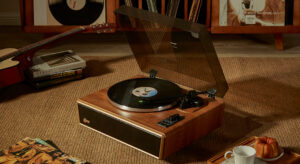
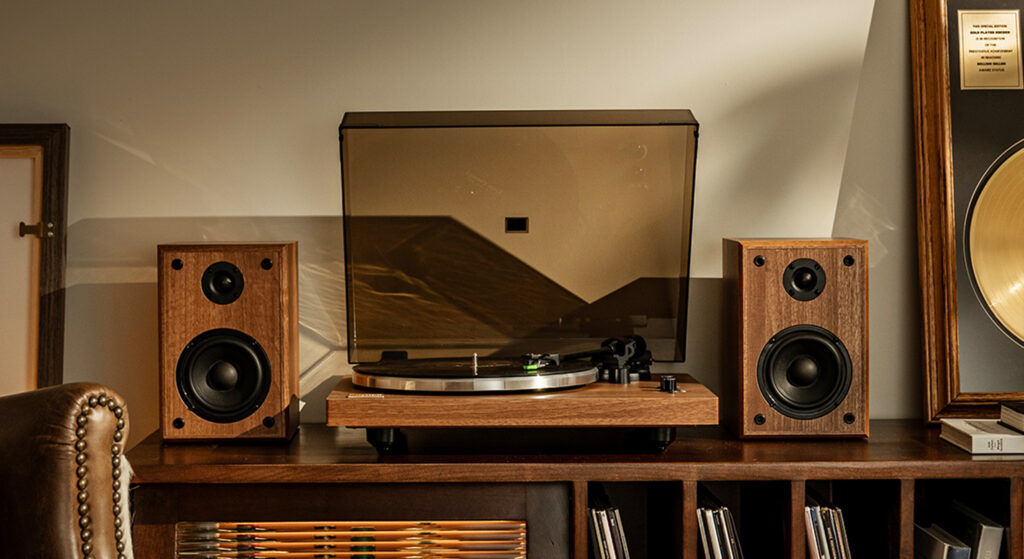
The Cassini’s walnut finish is the first thing anyone notices. It’s warm, tactile, and sits confidently in any interior style — mid-century modern, Scandi minimal, or classic Americana. Unlike the Polaris II’s all-white modular look, the Cassini is quieter and more versatile as a piece of furniture.
Build quality is solid for the price. The plinth feels substantial. The dust cover hinges operate smoothly. The 40W bookshelf speakers arrive with a finish that complements the turntable — they’re designed to sit alongside it, not just near it.
Iron Platter
The hefty iron platter is a feature that doesn’t photograph well but matters when you listen. More mass means more rotational inertia, which means smaller speed variations between motor pulses. The result is tighter playback with less wow and flutter than you’d expect at $329.
Sound Quality
The AR-N60 Cartridge
Arkrocket fits the Cassini with their AR-N60 Rocket Moving Magnet cartridge, the same unit used across the Premier lineup. It’s a competent MM cartridge — user-replaceable, compatible with any standard phono input, and voiced warmly without sacrificing detail in the upper midrange.
One practical note: the recommended tracking force is 3.5g. Verify this before your first record. Tracking too light will cause skipping; too heavy accelerates stylus and record wear. Take two minutes with a stylus gauge if you have one — it’s worth it.
Set your tracking force to 3.5g before the first spin. It’s the single most important setup step on the Cassini.
The 40W Bookshelf Speakers
The included speakers are 2×20W, totaling 40W. In a 12×15 foot room, they’re loud enough at two-thirds volume. Bass is controlled rather than exaggerated — this suits vinyl playback, where over-boosted bass can cause the stylus to lose groove contact on dynamic passages.
What sets the Cassini’s speaker situation apart: these speakers have Bluetooth input. You can stream from your phone directly to the speakers, without the turntable even being on. That gives you a capable wireless speaker pair that also happens to work brilliantly with vinyl.
Bluetooth — the Feature That Matters Most
The Cassini’s most important specification is one that competitors routinely get half-right: full Bluetooth in and out.
The turntable has Bluetooth output — stream your vinyl wirelessly to headphones, a soundbar, or any BT speaker. The included bookshelf speakers have Bluetooth input — stream music directly from your phone. These are two independent Bluetooth paths, and both work simultaneously in their respective roles.
The 3.5mm aux-in adds a third input option for sources that aren’t Bluetooth-capable. Combined with RCA output for external amplifiers, the Cassini connects to virtually any audio setup you can throw at it.
Auto-Stop — Small Feature, Big Deal
The Cassini is a manual turntable with auto-stop. You lower the tonearm yourself, but when the record ends, the motor stops automatically. This is the ideal configuration at this price: you get the ritual of placing the needle, but you don’t risk the stylus grinding at the end of the record if you walk away.
Cassini vs. Polaris II vs. Huygens
Since all three live in the Arkrocket Premier lineup, it’s worth being direct about the differences:
The Huygens ($289.99) has built-in speakers rather than separate bookshelf units, and Bluetooth output only. It’s the compact, all-in-one option.
The Cassini ($329.99) steps up to separate 40W bookshelf speakers, full Bluetooth in/out, iron platter, and aux-in. It’s the most versatile of the three.
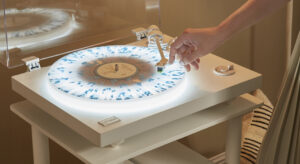
The Polaris II ($389.99) adds an LED-illuminated platter, an all-white modular design, and a more visual presence. The speakers are comparable in power, but the Cassini’s iron platter arguably gives it an edge in pure playback stability.
For most buyers, the Cassini is the right answer. It’s where the diminishing-returns curve bends in your favor.
Final Verdict
The Arkrocket Cassini is the most complete all-in-one turntable system the brand makes. At $329.99, it delivers a finish quality and feature set that would cost significantly more from European brands. The walnut looks right in any room, the iron platter sounds better than its price suggests, and the full Bluetooth in/out implementation is the single most useful feature in the category.
Set your tracking force. Pair the speakers. Put on a record. The rest takes care of itself.
- Walnut finish looks genuinely premium
- Full Bluetooth IN + OUT — rare at this price
- 40W bookshelf speakers fill a real room
- Heavy iron platter reduces vibration noticeably
- Auto-stop protects stylus after record ends
- 3.5mm aux-in for non-Bluetooth sources
- Built-in phono preamp — plug and play
- Best value in the Arkrocket Premier lineup
- Manual tonearm placement (not automatic)
- Factory tracking force may need adjusting to 3.5g
- No 78 RPM support
- Walnut finish shows fingerprints on gloss panels