This is one part of a larger topic. For the full picture — cartridge types, stylus shapes, tracking force, alignment and replacement — see Turntable Cartridges and Styli: The Complete Guide.
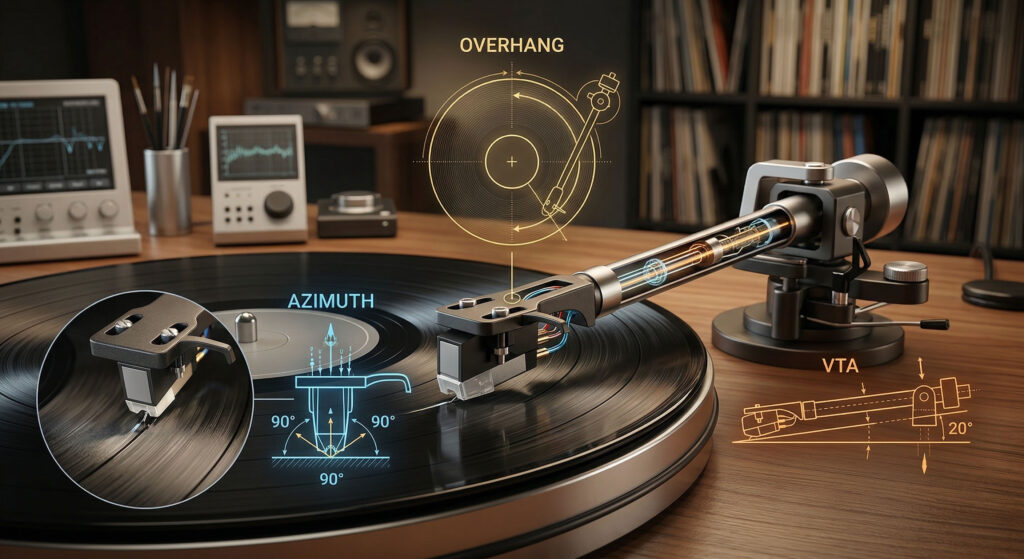
Cartridge alignment has three geometric parameters: overhang (how far the stylus extends past the spindle — sets where the stylus tracks on the arc), azimuth (left-right tilt of the cartridge — affects channel balance and stereo separation), and VTA / vertical tracking angle (the stylus angle in the groove — affects tonal balance). Most record players come factory-aligned. Most listeners never need to touch these. But understanding what they do explains why alignment matters — and what to listen for when something is off.
Tonearm alignment is where vinyl setup becomes genuinely technical — a world of protractors, null points, and fractions of a degree. It is also one of those topics that attracts obsessive precision far beyond what most systems can resolve. The goal of this lesson is to explain what each adjustment actually does, what wrong alignment sounds like, and when you should and shouldn’t attempt adjustment.
Overhang, Azimuth, VTA — What Each One Controls
Use a protractor
How to set: alignment protractor placed on the platter. Stylus placed at each null point; cartridge body aligned to the grid lines at both.
Average overhang: 12–16mm depending on tonearm geometry.
Most critical for stereo
How to set: view the cartridge from the front with a small mirror under the stylus; cantilever should appear perfectly vertical. Most factory-installed cartridges are pre-set correctly.
Adjustment: rotating the cartridge in the headshell slot, or headshell on some arms.
Affects tonal balance
Arm too low (rear lowered): sound becomes warmer, fuller, but loses clarity and “air” at the top.
Correct: tonearm runs parallel to record. Adjusted by raising or lowering the tonearm pillar, or using headshell shims. Not available on fixed-height tonearms.
What Wrong Alignment Actually Sounds Like — Reference Guide
| Symptom | Most likely cause | What to adjust |
|---|---|---|
| Harsh sibilance on all records | Overhang misaligned, VTA too high, or tracking force too low | Check overhang with protractor; lower rear of tonearm slightly; re-check tracking force |
| One channel louder than the other | Azimuth tilted; anti-skate wrong | Check azimuth — is cantilever vertical from front view? Check anti-skate setting |
| Stereo image not centered; instruments pull left or right | Azimuth off; less commonly overhang | Verify cantilever is perpendicular to record surface when viewed from front |
| Distortion worst in inner grooves | Overhang misaligned (null points in wrong position) | Realign with protractor, ensuring both null points are correctly set |
| Sound too warm/dull, lacking detail | VTA too low (tonearm rear too low); or tracking force too high | Raise rear of tonearm slightly; verify tracking force |
| Sound bright on one record, dull on another | Record thickness variation affecting VTA | Set VTA for average record thickness; accept minor variation |
Tonearm alignment steps must be done in the correct order because each setting affects the others:
1. Level the turntable platter
2. Set tracking force
3. Set overhang (with protractor)
4. Check azimuth
5. Set VTA (tonearm parallel to record)
6. Set anti-skate
7. Fine-tune by listening
Never adjust VTA before overhang is set — the tonearm height affects the overhang measurement slightly on some arms.
Who Needs to Adjust Alignment — and Who Doesn’t
Cartridge alignment is a tool for building a system from components — separate tonearm, separate cartridge, adjustable headshell. Most integrated record players have this relationship fixed at the factory with purpose-built jigs and cannot and should not be adjusted by the user.
On an Arkrocket record player with a fixed cartridge and fixed tonearm geometry, alignment is set at the factory for the specific cartridge and arm combination. There is no protractor work to be done. The correct response to distortion or channel imbalance on a factory-aligned record player is to check tracking force, clean the stylus, check the record, and verify anti-skate — not to attempt cartridge alignment.
The Alignment Protractor — What It Is and How to Use It
An alignment protractor is a template printed on paper or engraved on a mirrored acrylic disc that sits on the platter spindle like a record. It shows two null point positions as crosshairs with parallel grid lines. The cartridge is moved in the headshell slot until the stylus sits on each crosshair and the cartridge body is parallel to the grid lines at both points.
Different alignment geometries place the two null points at different positions across the record, optimizing for different priorities. Baerwald minimizes average distortion across the whole side — the most common choice. Stevenson minimizes distortion in the inner grooves specifically — used in some Japanese tonearm designs. Löfgren minimizes peak distortion. For most listeners, Baerwald is the right starting point. Use whichever geometry your tonearm manufacturer specifies if one is recommended.
Tonearm alignment is genuinely important — a misaligned cartridge loses real sonic performance that no amount of cartridge upgrades can compensate for. But it is also a topic that generates far more anxiety than necessary. For the majority of record player owners — including all Arkrocket record player users with factory-installed cartridges — alignment is already done correctly and requires no attention. For those building component systems with adjustable tonearms and separately installed cartridges, a $15–30 protractor and patience for one careful afternoon of setup delivers a properly aligned system that rarely needs revisiting. Understand the concepts; apply them only when they’re actually needed.
Interested in the products mentioned? Shop Arkrocket directly:
Browse Arkrocket Record Players →