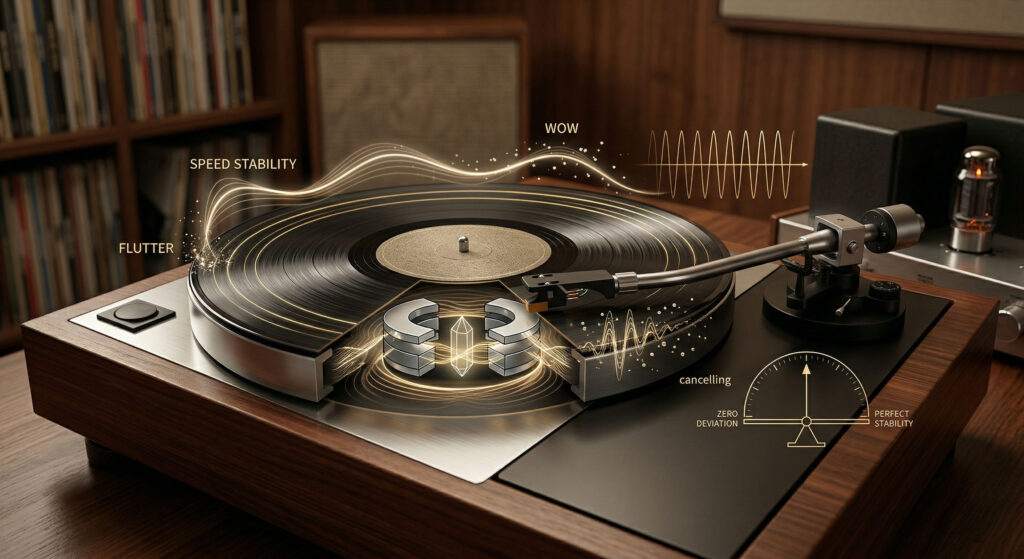
Wow is slow speed variation — a gradual wavering in pitch, like a note sung slightly flat then sharp. Flutter is fast speed variation — a rapid, trembling instability in pitch. Both are measured as a percentage of the nominal speed, and both are audible on sustained notes like piano, cello, or solo voice. Below 0.2% is acceptable; below 0.1% is good; below 0.05% is excellent.
Speed stability is one of those record player specifications that most people never think about — until they hear a turntable with poor speed stability. Then they hear it everywhere. A piano note that should be perfectly sustained instead sounds slightly seasick. A violin section that should shimmer sounds unsteady. It is immediately, unmistakably wrong.
A record player spinning at perfectly constant speed would reproduce pitch with perfect fidelity. In reality, every mechanical system has some speed variation. The engineering question is how much, how fast it varies, and whether the human ear can detect it.
Wow vs Flutter — What’s the Difference
In practice, wow and flutter are always measured together as a single combined figure — written as W&F or wow & flutter. The combined number represents the total speed variation across both slow and fast frequencies, weighted by how sensitively the human ear responds to each rate of change.
Wow & Flutter Numbers — What to Look for When Buying a Record Player
Speed instability is most audible on instruments with sustained, pure tones and no natural vibrato: unaccompanied piano, solo cello, solo flute, classical guitar, and solo voice singing a held note. It is almost completely inaudible on complex, rapidly changing music — rock, electronic, and orchestral passages where many instruments overlap mask any pitch variation. If you want to check your record player for wow and flutter, play a piano recording with held chords in a quiet room and listen for wavering.
What Causes Wow and Flutter in a Record Player
Belt Drive vs Direct Drive — Which Is More Stable?
This is one of the most debated topics in vinyl. The honest answer is that both can achieve excellent wow and flutter numbers — the difference is in how each maintains speed.
Belt drive relies on platter inertia — a heavy, well-balanced platter that resists speed changes between motor pulses. Once up to speed, a heavy platter is very stable; the belt isolates the motor’s cogging from the platter. Weakness: belt condition matters enormously; a degraded belt dramatically worsens wow.
Direct drive uses a servo system — electronics that constantly monitor platter speed and correct deviations in real time. This gives very consistent average speed and excellent long-term stability, but the constant micro-corrections can introduce a characteristic sound that some listeners find slightly different from the pure inertia-based stability of a heavy belt drive platter.
In practice: a well-maintained belt drive record player with a good belt and heavy platter can achieve 0.05% or better. A quality direct drive achieves similar numbers through electronic precision. Budget direct drives can have servo-hunting artifacts; budget belt drives can have belt-related wow. Drive type alone doesn’t determine the result.
How to Check Speed Stability at Home
Most record players ship with a strobe disc — a paper disc with a pattern of dots or lines that, when viewed under a fluorescent light (or a strobe light app on your phone), appears stationary if the platter is spinning at the correct speed. If the pattern drifts clockwise, the platter is running fast; anticlockwise means slow. This checks average speed accuracy, not wow and flutter.
For wow and flutter: Free smartphone apps (RPM Speed, PlatterSpeed) use the phone’s gyroscope to measure actual speed variation. Place the phone flat on the platter (no record), start the motor, and the app plots speed variation over time. This gives a rough W&F figure — useful for detecting obvious problems like a stretched belt, less accurate than a dedicated meter.
All the smartphone apps and strobe discs in the world are secondary to listening. Put on a familiar piano recording or a sustained cello note on a well-known album. Close your eyes and listen specifically to whether pitch is stable. If held notes sound wavery or slightly seasick, your record player has a speed stability problem. Clean the belt, check the belt condition, and make sure the platter bearing has adequate lubrication. In most cases, replacing a worn belt on a belt drive record player resolves audible wow within minutes.
Wow and flutter is the specification that most buyers overlook and most listeners notice immediately when it’s wrong. For a record player at any price point, look for a combined W&F figure below 0.2% — and below 0.1% for anything you’d call a quality machine. The practical implication: keep the belt in good condition on a belt drive record player, keep the bearing lubricated, and place the record player on a stable surface isolated from speaker vibration. A well-maintained record player with a fresh belt and clean bearing will deliver excellent speed stability regardless of its age or price. Speed stability is maintenance, not just specification.
Interested in the products mentioned? Shop Arkrocket directly:
Browse Arkrocket Record Players →