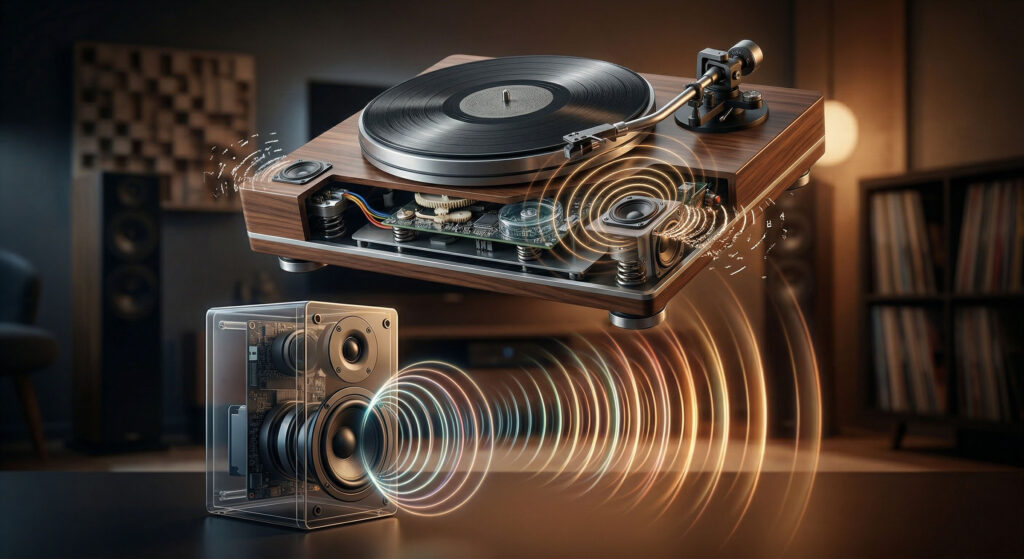
1. Acoustic feedback — speakers vibrate; the stylus picks those vibrations up and replays them, creating a feedback loop that muddies the sound and limits maximum volume.
2. Small drivers can’t move enough air — there is no engineering workaround for a tiny speaker producing deep bass. Physics sets a hard limit on what a small cone can do.
3. Shared budget — every dollar spent on building speakers into a record player is a dollar not spent on the motor, tonearm, cartridge, or platter. Something always loses.
All-in-one record players with built-in speakers are genuinely useful — they are convenient, self-contained, and require no additional equipment. Understanding why their sound has a ceiling isn’t a criticism of that design choice. It’s understanding a physics problem that cannot be engineered away, only managed. The Arkrocket Huygens and Cassini include built-in speakers with exactly this philosophy: well-engineered within real constraints, designed for listeners who value simplicity alongside sound quality.
Acoustic Feedback — Why Speakers and Stylus Cannot Share a Room
The stylus on any record player is one of the most sensitive vibration detectors ever made. It is engineered to track movements measured in nanometers — displacements so small they are invisible to any microscope available to consumers. That extraordinary sensitivity is what makes vinyl sound so detailed and alive.
It is also what makes a speaker attached to the same chassis a problem.
vibrates to make sound
sound waves
vibration
picks up vibration
amplifies it again
The speaker produces sound by vibrating. Those vibrations travel through two paths simultaneously: through the air as sound waves, and through the chassis as mechanical vibration. The stylus — sensitive to vibrations a thousand times smaller than anything you can feel — picks up both. The cartridge converts them to an electrical signal, the amplifier amplifies that signal, and the speaker reproduces it louder. Which creates more vibration. Which reaches the stylus again.
This feedback loop has three audible consequences. At low volume, it creates a slight thickening of the bass — a muddy, resonant quality. At higher volumes, it produces a progressive loss of clarity as the feedback overwhelms the signal from the groove. At some threshold, it breaks into obvious howling or distortion. The maximum usable volume of any built-in speaker record player is set by when feedback becomes intolerable — not by the amplifier’s power or the speaker’s capability.
The classic plastic suitcase record player places the speakers in the same lid as the record player, sometimes directly above the spinning record. The chassis is lightweight plastic — which transmits vibration freely rather than absorbing it. The speakers fire directly toward the record. This is the most acoustically hostile arrangement possible for a stylus, which is why these units consistently produce the worst sound quality regardless of how much they cost.
Small Speakers Cannot Move Enough Air — There Is No Workaround
Bass frequencies require a speaker cone to displace a large volume of air. Low frequencies are long waves — a 60Hz bass note has a wavelength of roughly 5.7 meters. Moving that much air requires either a large cone, a long cone excursion, or both. There is no engineering technique that allows a 2-inch speaker to produce meaningful bass. Physics sets a hard limit that no amount of digital processing or clever cabinet design can overcome.
This is not a complaint about built-in speaker record players — it is a statement about physics. A record player designed to be a self-contained unit at a reasonable price cannot include a large, well-braced speaker enclosure. The trade-off is real and unavoidable. The sound can be pleasant and musical — the Arkrocket Huygens produces enjoyable sound from its built-in speakers — but it will always be limited in bass extension and dynamic range compared to separate speakers.
The Shared Budget Problem — Something Always Loses
Building a good record player requires investment in: the motor and platter system, the tonearm and bearing, the cartridge and stylus, the phono preamp circuit, and the chassis and vibration isolation. Building good speakers requires investment in: the driver design, the crossover, the cabinet bracing and damping, and the amplifier circuit.
When all of these components share a single product budget, every category receives less than it would in a dedicated unit. A $300 all-in-one record player with built-in speakers has roughly $150 worth of record player and $150 worth of speaker — at a price point where neither is exceptional. A $200 record player paired with a $150 set of powered bookshelf speakers delivers a categorically better result in both categories.
Physical separation — the speaker enclosures are designed to minimize vibration transmission to the platter and tonearm, with isolation between the speaker chassis and the record player mechanism.
Bluetooth output — both models include Bluetooth output, allowing users to bypass the built-in speakers entirely and connect external powered speakers wirelessly. This is the single most effective upgrade path: keep the Arkrocket record player’s turntable mechanism, add separate speakers.
RCA line output — a wired RCA output allows connection to any powered speaker or amplifier, giving full range sound without the built-in speaker limitations.
The built-in speakers are for convenience. The outputs are for when you want to hear what the record actually sounds like.
How to Get the Most From a Built-In Speaker Record Player
The single biggest sound quality improvement available to any built-in speaker record player owner is routing audio through external speakers. This simultaneously eliminates acoustic feedback (speakers are physically separated from the record player), gains access to larger drivers capable of real bass, and removes the budget trade-off of the all-in-one design.
Via Bluetooth — pair the Arkrocket Huygens or Cassini with any Bluetooth speaker or soundbar. Eliminates feedback, gains speaker quality, zero additional cables.
Via RCA cable — connect to any powered bookshelf speaker via the RCA Line output. Higher audio quality than Bluetooth, still simple setup.
The record player mechanism — belt drive, Rocket MM cartridge, built-in phono preamp — remains exactly the same. Only the speaker changes. And that change is dramatic.
If you use external speakers with your record player, keep them on a separate surface from the record player — not the same shelf or table. Speaker vibrations travel through shared surfaces and reach the platter even without a shared chassis. The ideal arrangement: record player on a dedicated shelf or stand, speakers at least 60cm away on their own stands or on a different piece of furniture. This alone eliminates structural feedback that compromises sound even with external speakers.
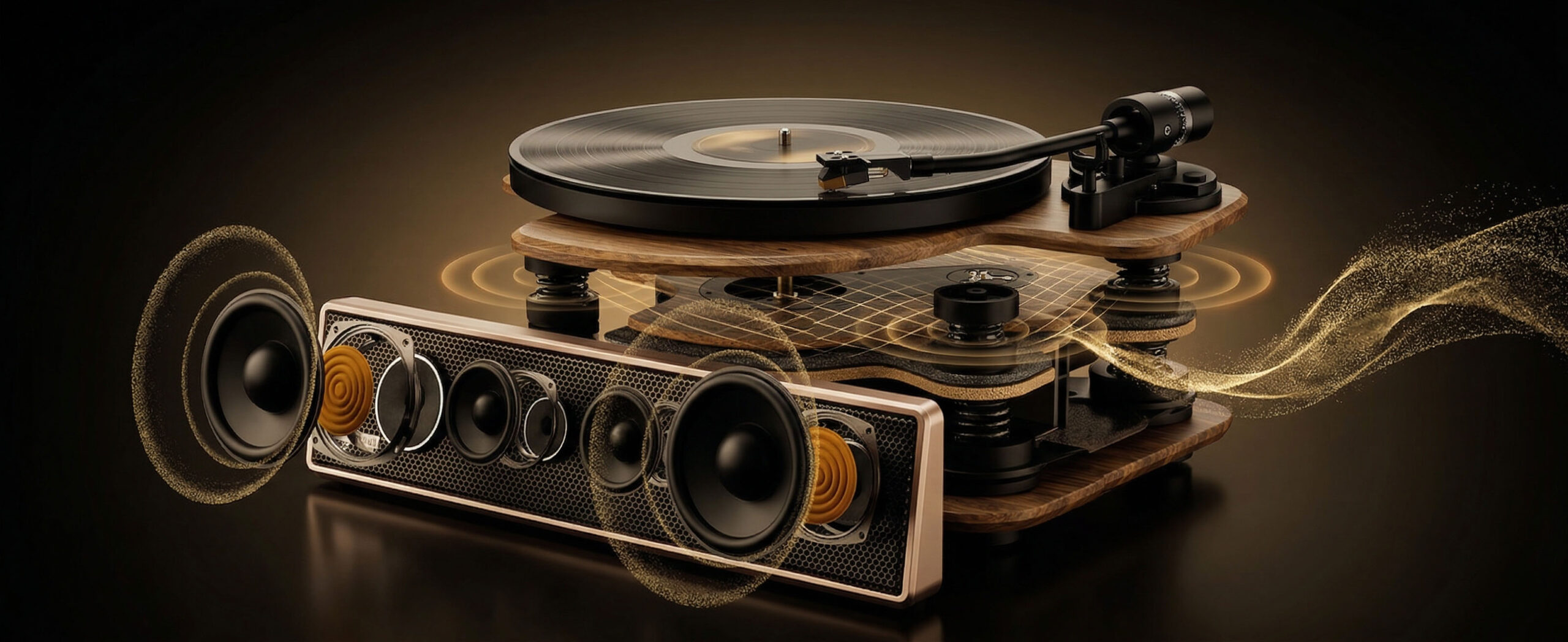
Find Your Arkrocket Record Player
Whichever listening style suits you — built-in speakers for simplicity, or separate bookshelf speakers for serious sound — there is an Arkrocket record player designed for it.
Built-in speakers on a record player are a genuine convenience that serves real listeners — not a compromise to be embarrassed about. But their sound ceiling is set by physics, not engineering choices: acoustic feedback limits volume, small drivers limit bass, and shared budgets limit both. The Arkrocket Huygens and Cassini handle this honestly — their built-in speakers sound pleasant for everyday listening, and their Bluetooth and RCA outputs provide a clear path to significantly better sound whenever you want it. Understanding the physics means knowing exactly when the built-in speakers are the right tool and when to reach for the RCA cable.
Interested in the products mentioned? Shop Arkrocket directly:
Browse Arkrocket Record Players →