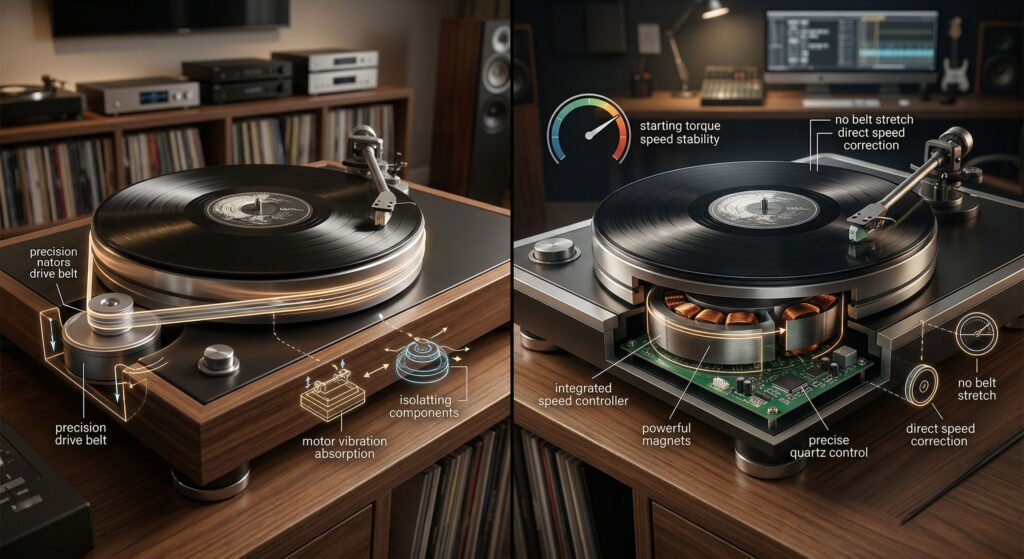
Belt drive — motor sits to the side, connected to the platter by a rubber belt that absorbs vibration. Preferred by audiophiles for home listening. The Arkrocket record player range uses belt drive.
Direct drive — motor sits directly under the platter and spins it. Faster start-up, higher torque, essential for DJs. The Technics SL-1200 is the definitive example.
When people discover this topic, they often expect a clear winner. The reality is more interesting: belt drive and direct drive are not competing versions of the same thing — they were engineered for different purposes, and both do their job extremely well. Understanding why each was designed the way it was makes the choice obvious for most listeners.
The Mechanism — What’s Actually Spinning the Record
This is the central trade-off. The rubber belt in a belt drive acts as a mechanical shock absorber — it is compliant and elastic, so motor vibrations are dissipated before they reach the platter. In a direct drive, the motor and platter are mechanically coupled with no isolation layer. Modern high-end direct drive record players invest heavily in motor engineering and vibration damping to address this — the Technics SL-1200 series, for example, achieves remarkably low rumble through precision motor design rather than isolation.
Belt Drive vs Direct Drive — Every Difference That Matters
| Feature | Belt Drive | Direct Drive |
|---|---|---|
| Motor position | Offset to the side | Directly below platter |
| Vibration isolation | Excellent — belt absorbs motor noise | Variable — depends on motor quality |
| Start-up speed | 2–4 seconds to full speed | Near-instant — full speed in under 1 second |
| Torque | Lower — platter can be slowed by hand | High — resists external force |
| Speed stability (wow & flutter) | Excellent with heavy platter | Excellent — servo-controlled |
| DJ use (scratching, cueing) | Not suitable — belt wears | Designed for it |
| Reverse play | Not possible — belt may slip | Possible on most models |
| Maintenance | Belt replacement every 3–7 years (~$5–20) | No belt to replace |
| Noise floor | Lower — motor isolated from platter | Higher on budget models; excellent on quality ones |
| Preferred by | Audiophiles, home listeners | DJs, broadcasters, high-end listeners |
| Price range | $100 → unlimited | $150 → unlimited |
Does Belt Drive Actually Sound Better?
The audiophile community has debated this for decades. The honest answer: in theory, belt drive has an inherent advantage at equivalent price points because the motor is mechanically isolated from the platter. In practice, the gap between a well-engineered direct drive and a well-engineered belt drive at the same price is narrow, and other factors — tonearm quality, cartridge, phono preamp — matter far more than drive type.
The Technics SL-1200 series — the most famous direct drive turntable ever made — is widely used by serious audiophiles and recording studios alongside DJs. Its motor engineering is so precise and its vibration damping so effective that it competes with audiophile belt drive record players costing several times more. Drive type is a useful starting principle, not a guarantee of outcome. A well-built direct drive beats a poorly built belt drive every time.
Direct drive uses a servo system that constantly monitors and corrects platter speed — the motor makes micro-corrections thousands of times per second. Belt drive relies on the inertia of a heavy platter to maintain speed between motor pulses. Both approaches achieve excellent wow and flutter specs. Some audiophiles argue that the continuous servo corrections in direct drive create a slightly different character to speed stability — more tightly controlled but with micro-variations from the correction mechanism. This is genuinely subtle and debated. What’s not debated: both are vastly superior to a worn or stretched belt, which causes audible pitch drift on a belt drive record player.
Belt Drive or Direct Drive — Who Should Choose Which
Every Arkrocket record player uses a belt drive system. This is the correct choice for home listening: the rubber belt isolates the motor’s vibration from the platter and stylus, resulting in a lower noise floor and cleaner sound at the same price point. The belt also protects the motor from damage if the platter is accidentally stopped — a practical benefit for everyday use. Belt replacement, if ever needed, costs a few dollars and takes five minutes.
Belt drive and direct drive are not better and worse — they are designed for different purposes. For home listening on a record player, belt drive’s inherent motor isolation gives it a measurable advantage at equivalent price points. For DJing, broadcasting, or any application requiring instant start-up, high torque, and manual platter manipulation, direct drive is the only sensible choice. Most record player owners are home listeners. For them, belt drive — including every Arkrocket record player — is exactly right.
Interested in the products mentioned? Shop Arkrocket directly:
Browse Arkrocket Record Players →