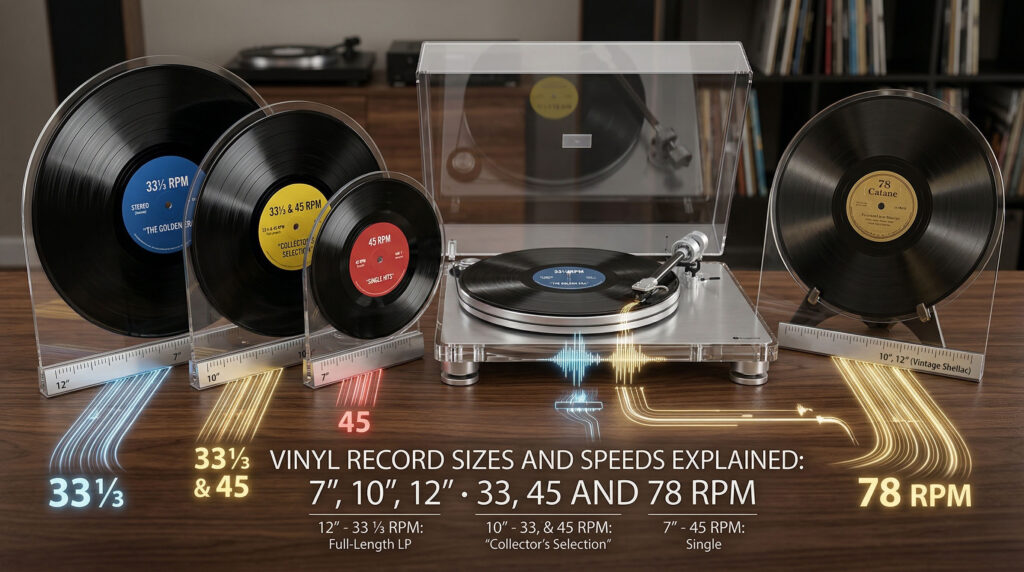
12″ at 33⅓ RPM = the standard album (LP) — up to 22 minutes per side. 7″ at 45 RPM = the classic single — up to 5 minutes per side. 10″ at 78 RPM = pre-1960 shellac records — a different material, different stylus, rarely played today. Every record player handles 33 and 45. Only specialist machines handle 78.
Walk into any record store and you’ll find black discs in three different sizes, occasionally labelled with speed numbers that seem arbitrary. They’re not. Each size and speed combination exists for a specific reason rooted in the physics of how music fits on a spinning disc — and in the commercial battles between record labels in the late 1940s.
7″, 10″ and 12″ — What Each Format Is For
A variation to know: the 12-inch single at 45 RPM — developed in the 1970s for DJs and audiophiles. With only one or two tracks per side spinning faster, the grooves can be cut wider and louder, extracting more dynamic range and detail from the format. Many audiophile pressings and DJ releases use 12″ at 45 RPM for this reason.
Speed: 33⅓ RPM
Playing time: up to 22 min/side
Spindle hole: small (standard)
Use: albums, LPs
You’ll need a 45 adapter (a plastic or metal insert that fills the large center hole) to play most 7-inch records on a standard turntable spindle. Most record players include one, or you can find them cheaply.
Speed: 45 RPM
Playing time: up to 5 min/side
Spindle hole: large (needs adapter)
Use: singles, EPs
In its modern form, the 10-inch occasionally appears as a vinyl EP or special release at 33⅓ RPM — an intermediate format between a single and a full album, sometimes used for EPs of 4–6 tracks. They are relatively uncommon and are typically collectible or audiophile releases.
Vintage: 78 RPM shellac
Modern: 33 RPM vinyl
Playing time: ~12 min/side at 33
Use: EPs, special releases
Why Speed Matters — The Physics of RPM and Sound Quality
There is a direct relationship between how fast a record spins and how much audio information fits in a given length of groove. Think of it this way: the faster the record turns under the stylus, the more groove passes the needle per second — and therefore the more detail can be encoded in that groove.
A record spinning at 45 RPM gives the stylus 36% more groove per second than a 33 RPM record of the same size. This means 45 RPM records can encode higher frequencies, wider dynamics, and more detail than the same content at 33 RPM. The trade-off is playing time: faster speed means more groove consumed per minute, so less music fits per side.
This is why audiophile pressings of albums often use two 12-inch records at 45 RPM instead of a single 12-inch at 33 RPM. Each side carries less music but at higher fidelity — a deliberate quality trade-off that serious listeners pay a premium for.
Playing Time Reference
| Format | Speed | Playing time per side | Typical use |
|---|---|---|---|
| 12 inch | 33⅓ RPM | Up to 22 minutes | Albums (LP) |
| 12 inch | 45 RPM | Up to 12 minutes | Audiophile / DJ singles |
| 7 inch | 45 RPM | Up to 5 minutes | Singles, B-sides, EPs |
| 7 inch | 33⅓ RPM | Up to 7 minutes | Extended play (EP) |
| 10 inch | 33⅓ RPM | Up to 12 minutes | EPs, special releases |
| 10 inch | 78 RPM | ~3–5 minutes | Vintage shellac (pre-1950s) |
78 RPM Records — A Completely Different Animal
The 78 RPM format predates vinyl entirely. These records were pressed from shellac — a brittle, heavy material derived from insect secretions — and were the dominant consumer format from roughly 1900 until the early 1950s. They were thick, heavy, and prone to shattering. A standard 10-inch shellac 78 could hold about 3–5 minutes per side.
Playing a vintage 78 RPM record on a modern record player requires three things your standard setup probably lacks: (1) a 78 RPM speed setting on the motor, (2) a special wide-groove 78 stylus — the groove width is roughly 4× wider than modern vinyl microgrooves, and a standard stylus will rattle around and damage both the record and itself, (3) ideally a mono cartridge, as early 78s were mono recordings.
The Arkrocket Coryphaeus ($159.99) is the model in the Arkrocket lineup with 78 RPM support. For most listeners, 78s are a specialist collecting interest — not an everyday format.
Size and Speed Are Independent — Not the Same Thing
The most common misunderstanding about vinyl formats is assuming that size determines speed. It doesn’t — not strictly. The common pairings (12″ = 33, 7″ = 45) are conventions, not rules.
12″ at 33⅓ RPM — standard album. Most records you’ll ever buy.
7″ at 45 RPM — standard single. Needs a 45 adapter for most record players.
12″ at 45 RPM — audiophile pressing or DJ 12″ single. Better sound quality, less playing time.
7″ at 33⅓ RPM — EP format. Occasionally used for extended play 7-inch releases.
10″ at 78 RPM — vintage shellac. Needs specialist equipment.
Your record player will have a speed switch labeled 33 and 45 (and sometimes 78). Always check the label on the record itself — it will state the correct speed. Playing at the wrong speed makes the music sound comically fast (too fast) or sluggishly slow (too slow).
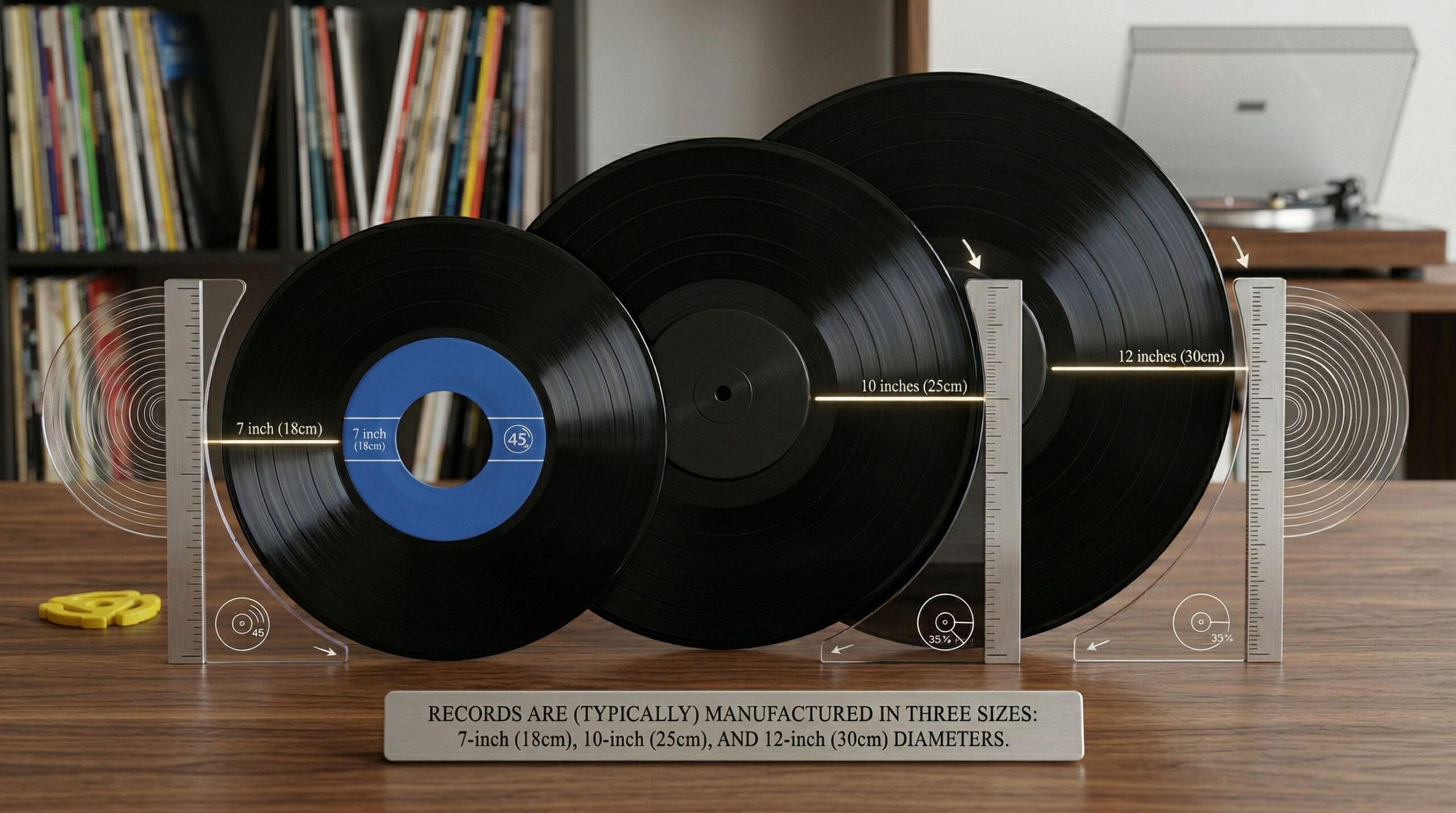
The 45 Adapter — What It Is and Why You Need It
When RCA Victor introduced the 7-inch 45 RPM single in 1949, they deliberately made the center hole larger than on 12-inch LPs — a design decision partly intended to differentiate the format and prevent Columbia LP record players from playing their records. The large hole (1.5 inches / 38mm vs the standard 0.286 inches / 7.3mm) means a 7-inch single won’t fit over a standard record player spindle without an adapter.
A 45 adapter is a small plastic or metal insert that fills the large center hole of a 7-inch record, allowing it to sit on a standard spindle. They cost $1–5 and are widely available. Many record players include one in the box. If yours didn’t, search for “45 RPM adapter” — they are universal. Keep one near your record player at all times if you plan to play any 7-inch singles.
For most listeners, the formats you’ll encounter are simple: 12-inch LPs at 33⅓ RPM for albums, and 7-inch singles at 45 RPM for songs. Every record player handles both. The 78 RPM format is a specialist territory requiring dedicated equipment. Understanding that size and speed are independent — and that 45 RPM sounds better but holds less — helps you understand why audiophile pressings exist and what you’re paying for when you buy a premium release.
Interested in the products mentioned? Shop Arkrocket directly:
Browse Arkrocket Record Players →