Vinyl 101

How Does a Record Player Work? From Groove to Speaker, Explained

March 29, 2026 · 12 min read
how does a record player work? from groove to speaker, explained
Vinyl 101 · Unit 2 · Lesson 2.1
The one-sentence answer

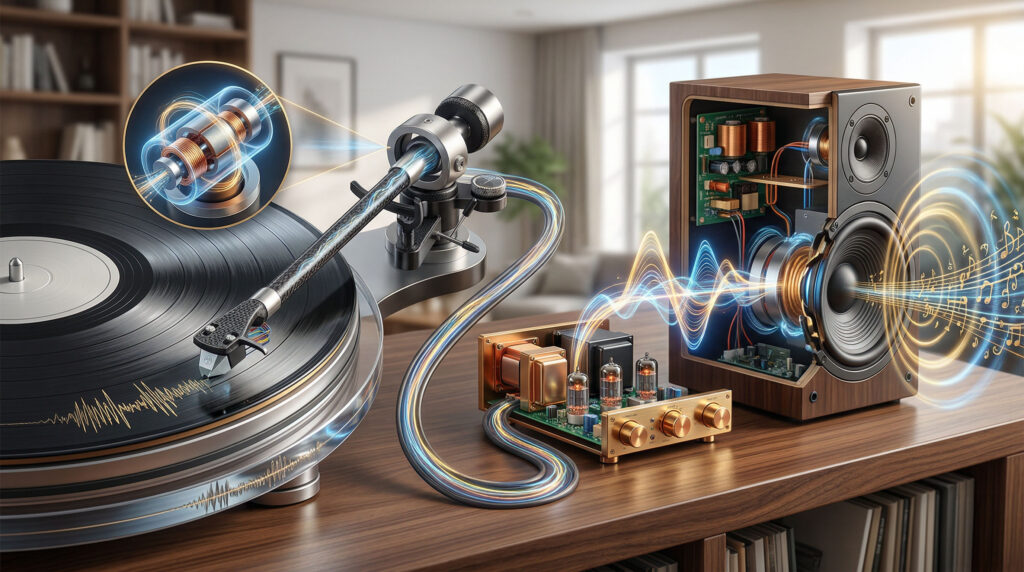
A record player works by dragging a diamond-tipped stylus through a physical groove carved into vinyl, converting the groove’s tiny vibrations into an electrical signal, amplifying that signal, and sending it to speakers. No digital processing, no software — just physics turning movement into music.

A needle dragging through a plastic groove probably shouldn’t be able to produce a full orchestra. And yet it does — with a clarity and warmth that millions of listeners still prefer over any digital format. Understanding how a record player actually works makes you a better listener, a smarter buyer, and someone who can diagnose problems when they appear.

The full journey from groove to speaker involves five steps. Each one is simple on its own. Together, they’re quietly remarkable.

The complete journey

From Groove to Speaker — Five Steps

1
The platter spins the record at a fixed speed
A motor rotates the platter — either directly (direct drive) or via a rubber belt (belt drive) — at a precisely controlled speed. Most records play at 33⅓ RPM (albums) or 45 RPM (singles). This constant, stable rotation is critical: any variation in speed causes pitch to waver, a defect called wow and flutter.
Key parts: motor, platter, bearing, drive belt or spindle

2
The stylus rides the groove and vibrates
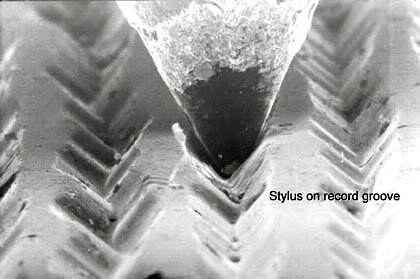
The stylus — a tiny diamond tip mounted at the end of the tonearm — sits inside the record’s groove. As the record spins, the groove’s microscopic undulations push the stylus sideways and vertically, thousands of times per second. These movements are a physical encoding of the original sound wave. The stylus simply follows them.
Key parts: stylus, cantilever, tonearm, counterweight, anti-skate

3
The cartridge converts vibration into electricity
The stylus is attached to a cantilever — a tiny arm — which connects to a cartridge. Inside the cartridge, the cantilever’s movement causes a magnet to move past a coil of wire (in a Moving Magnet cartridge), inducing a tiny electrical current. The pattern of that current is an exact electrical replica of the groove’s physical shape — and therefore of the original sound.
Key parts: cartridge, cantilever, magnet, coil. Output: ~3–5 millivolts (phono level)

4
The phono preamp amplifies and corrects the signal
The cartridge’s output is far too weak for a regular amplifier — roughly 40× quieter than a CD player. The phono preamp boosts it to standard line level and applies RIAA equalization: reversing the deliberate bass-cut and treble-boost that were applied during record cutting. Without this step, the music would sound thin, quiet, and tonally wrong.
Key parts: phono preamp (built-in or external). Output: ~200–300 mV (line level)

5
The amplifier and speakers convert electricity into sound
The line-level signal reaches the amplifier, which multiplies its power to drive speakers. Inside each speaker, the electrical signal moves a voice coil in a magnetic field, pushing a cone back and forth — recreating the original air pressure waves. Those waves reach your ears as music.
Key parts: amplifier, speaker drivers, speaker cabinet

Record player anatomy — platter, tonearm, cartridge and stylus

Energy type:

Mechanical
groove vibration

Electrical
millivolt signal

Electrical
line level

Mechanical
speaker cone

Sound
air pressure waves

Every component and its job

The Parts of a Record Player — What Each One Does
🏠
Plinth (base)
The chassis that holds everything together and absorbs vibration. A heavier, more rigid plinth reduces resonance from the motor, environment, and speakers from reaching the tonearm. High-end record players use wood, acrylic, or dense MDF for this reason.

⚙️
Motor & drive system
The motor spins the platter via a direct drive (motor under the platter) or belt drive (motor offset, connected by rubber belt). Belt drive isolates motor vibration from the platter. Direct drive starts faster and is preferred by DJs for its torque and stability.

💿
Platter
The rotating disc the record sits on. Heavier platters have more rotational inertia — they resist speed variations more effectively, resulting in more stable pitch. Budget record players use thin plastic platters; better ones use thick aluminum, acrylic, or glass.

🦾
Tonearm
The pivoting arm that holds the cartridge over the record. Its job is to guide the stylus across the record with minimal friction and precise tracking force. A good tonearm uses low-friction bearings and is made from rigid, lightweight materials like aluminum or carbon fiber.

⚖️
Counterweight & anti-skate
The counterweight at the rear of the tonearm balances it so the stylus presses on the record at a precise, adjustable force (tracking force). Anti-skate counteracts the natural tendency of the tonearm to pull inward during playback, keeping the stylus centered in the groove.

💎
Cartridge & stylus
The cartridge is the transducer — the device that converts mechanical energy into electrical energy. The stylus (diamond tip) reads the groove; the cantilever transmits its movement to the magnet and coil inside the cartridge body. This is the most sound-critical component in the entire chain.

🔌
Phono preamp
Amplifies the cartridge’s weak millivolt output to line level, and applies RIAA equalization to restore correct frequency balance. May be built into the record player, into the amplifier, or purchased as a separate unit. Every setup needs one somewhere in the chain.

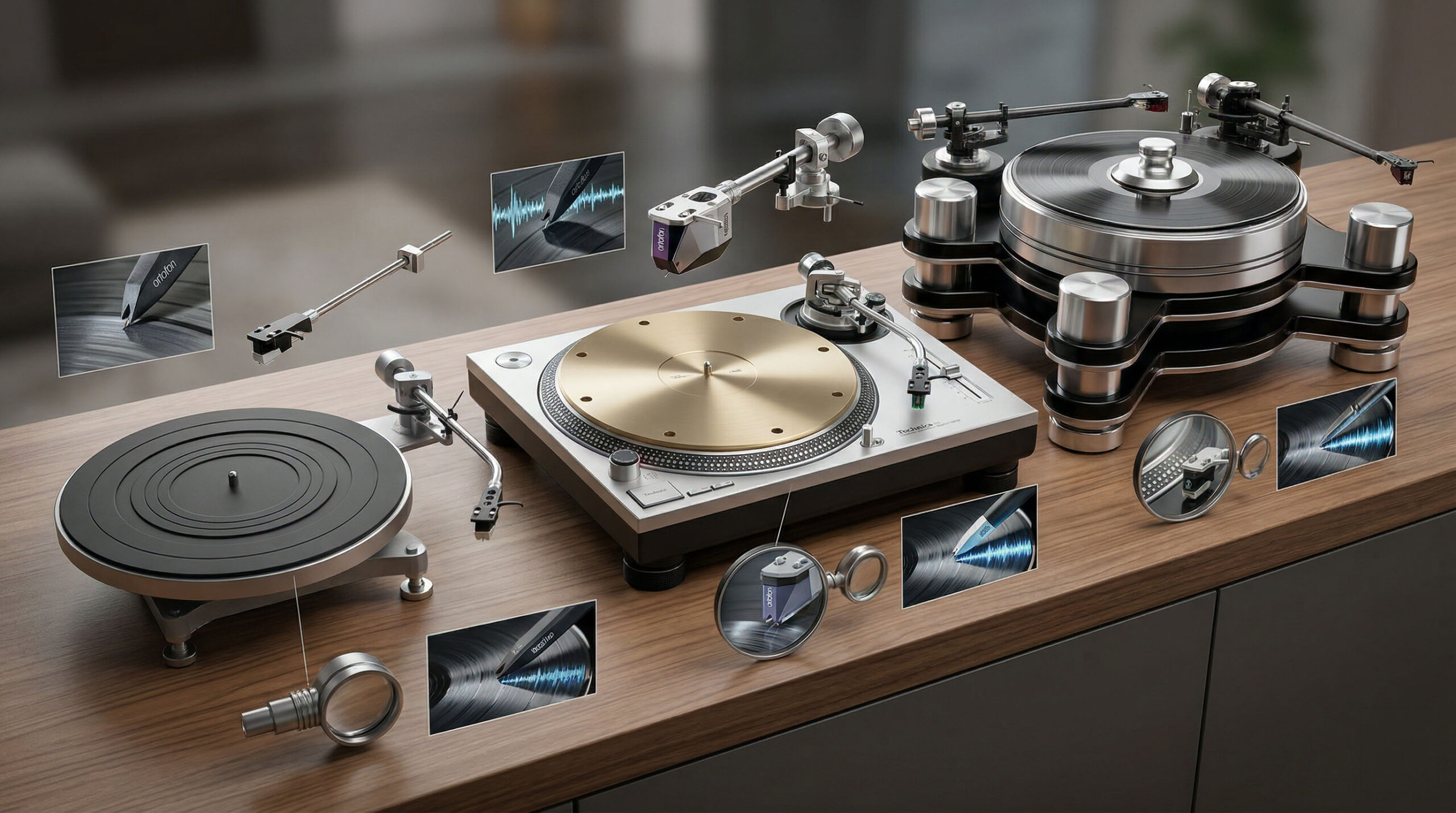
Record player anatomy — platter, tonearm, cartridge and stylus

Every record player — from the most basic to the most expensive — contains the same fundamental parts: platter, tonearm, cartridge, and stylus. The quality of each component determines how accurately the groove’s information is retrieved and how well the record is protected.

What’s actually in the groove

The Groove — How Sound Is Physically Encoded in Plastic

The most remarkable thing about a vinyl record isn’t the player that reads it — it’s the record itself. A standard LP has a single continuous groove that spirals from the outer edge to the inner label over roughly 1,500 feet of total length. The groove is approximately 0.04mm wide — about half the width of a human hair.

Inside that groove, the walls are not straight. They contain microscopic lateral and vertical undulations — the physical representation of the sound waveform. When the original music was recorded, a cutting lathe drove a heated stylus through a lacquer disc, carving groove shapes that exactly corresponded to the audio signal. Every cymbal crash, bass note, and vocal nuance is encoded as a specific shape in the groove wall.

How stereo fits in a single groove

A stereo record encodes two channels in a single groove using the 45/45 system. The left channel is encoded in the inner groove wall at a 45° angle; the right channel in the outer groove wall at 45°. The stylus reads both walls simultaneously, and the cartridge separates the signals. This is why tilting or misaligning the cartridge affects channel balance — a perfectly aligned stylus reads both walls equally.

The character of analog sound

Why Vinyl Sounds Different from Digital

This is a topic that fills books and fuels arguments. The brief, honest explanation:

Digital audio captures sound by sampling it at a fixed rate (44,100 times per second for CD quality). Each sample is a number. The resulting audio is mathematically precise — but it is a series of discrete measurements, not a continuous wave.

Analog audio — vinyl — is a continuous physical waveform. The groove wall’s shape is a direct physical analogue of the original air pressure wave. There are no samples, no quantization steps, no digital processing. The stylus reads an exact physical copy of the original sound, limited only by the quality of the cutting and playback equipment.

The “warmth” of vinyl — what’s actually happening

The characteristic warmth and richness often associated with vinyl is partly the result of harmonic distortion — small amounts of even-order harmonic content introduced by the cartridge and analog circuitry. Human hearing tends to find even-order harmonics pleasing rather than grating. Digital formats have different distortion characteristics. Neither is objectively more “accurate” — they are different, and many listeners have a genuine preference for one over the other.

Why this matters when you buy

Why Understanding the Chain Makes You a Better Buyer

Every step in the signal chain affects the final sound. Knowing the chain helps you identify where to invest and where problems come from:

The most impactful components — in order

1. Cartridge and stylus — the first point of contact with the record. Stylus shape, tip quality, and tracking force affect both sound quality and record wear more than any other single component.

2. Phono preamp — a poor phono preamp introduces noise and RIAA inaccuracy that colors everything downstream. An upgrade from a budget built-in to a $40–$80 external preamp is often the most cost-effective improvement.

3. Tonearm quality — bearing friction and arm mass affect how accurately the stylus tracks the groove, especially in complex passages and near the inner grooves.

4. Platter and motor stability — wow and flutter (speed instability) cause pitch wavering that is immediately audible on sustained notes and piano.

5. Plinth isolation — external vibrations reaching the stylus create rumble and can cause acoustic feedback at high volumes.

This hierarchy explains why a $299 record player with a quality MM cartridge and a solid plinth often outperforms a $500 record player with a poor cartridge. The cartridge is the conversion point — everything before it (motor, platter, tonearm) determines how accurately it reads the groove, and everything after it (preamp, amplifier, speakers) determines how well that reading is reproduced.

RecordPlayerLab verdict

A record player is a precision mechanical instrument that converts the physical shape of a groove into music through a chain of energy transformations — mechanical to electrical to acoustic. Every component in that chain matters, and understanding what each one does makes every future purchase decision clearer. The stylus is where music begins. Everything else either preserves or compromises what the stylus finds in the groove.

All Vinyl 101 Lessons →

vinyl 101
how does a record player work
how vinyl works
record player explained
cartridge
stylus
signal chain
phono preamp
tonearm
vinyl groove
beginner guide

Interested in the products mentioned? Shop Arkrocket directly:

Browse Arkrocket Record Players →
← Back to RecordPlayerLab
Language