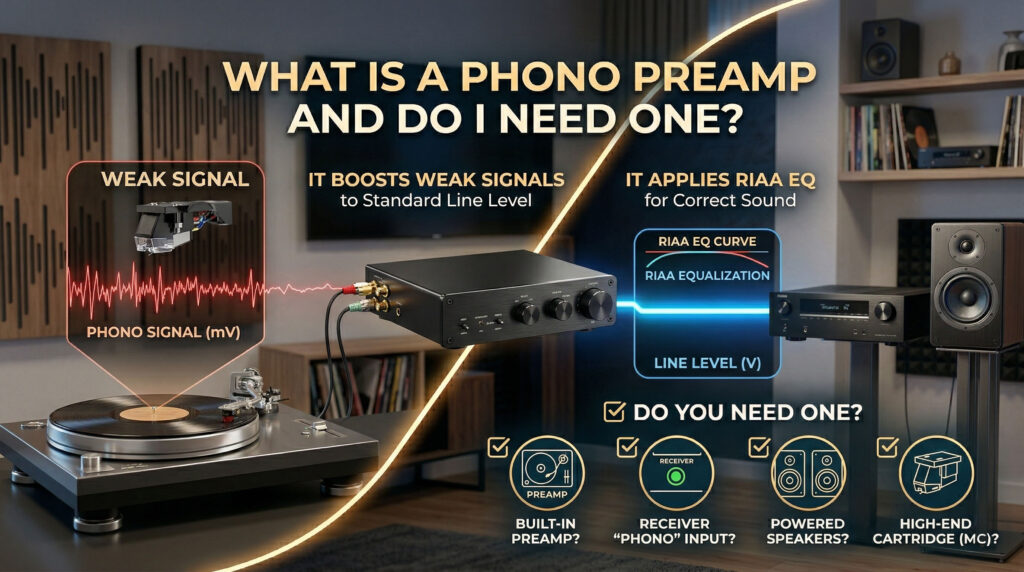
Yes — every turntable setup needs a phono preamp somewhere in the chain. The question is whether it’s already built into your turntable, your speakers, or your amplifier — or whether you need to add a separate one. Plugging a turntable without a phono preamp into a regular amplifier input is the most common mistake in vinyl setup. The result: almost no sound, or a thin, tonally wrong signal that sounds broken.
Of all the things that confuse vinyl beginners, the phono preamp is the one that causes the most real-world failures. Someone buys a turntable, connects it to their amplifier or powered speakers, and hears almost nothing. They think the turntable is defective. They think the speakers don’t work. They return the equipment. In nearly every case, the problem is simply a missing phono preamp.
Understanding why it exists — and how to tell if you have one — takes about three minutes. That’s what this lesson is for.
The Problem: A Signal That’s 40× Too Quiet
When a stylus rides the groove of a vinyl record, it vibrates. A coil of wire inside the cartridge moves through a magnetic field, and that movement generates a tiny electrical signal. The operative word is tiny.
Compare signal levels across common audio sources:
A turntable cartridge outputs roughly 3 to 5 millivolts. A CD player or phone outputs 200 to 400 millivolts — around 40 to 100 times more. An amplifier’s AUX input is designed for line-level signals. Connect a turntable to it without a phono preamp and you’ll hear music at about 2% of normal volume, buried under hiss, with completely wrong tonal balance.
The phono preamp’s first job is to boost this weak phono-level signal up to line level — the standard that every other piece of audio equipment expects.
The RIAA Curve: Why Vinyl Records Are Intentionally Wrong
The phono preamp has a second, less obvious job: correcting a deliberate frequency distortion that’s baked into every vinyl record ever made since 1954.
Here’s the problem that record engineers faced: low-frequency bass notes have very long wavelengths. Cut at full volume, the grooves for a bass note would need to be extremely wide — so wide that only a few minutes of music could fit on each side of an LP. Meanwhile, high-frequency treble notes have tiny, delicate groove variations that get overwhelmed by surface noise during playback.
The solution, standardized in 1954 by the Recording Industry Association of America, was ingenious:
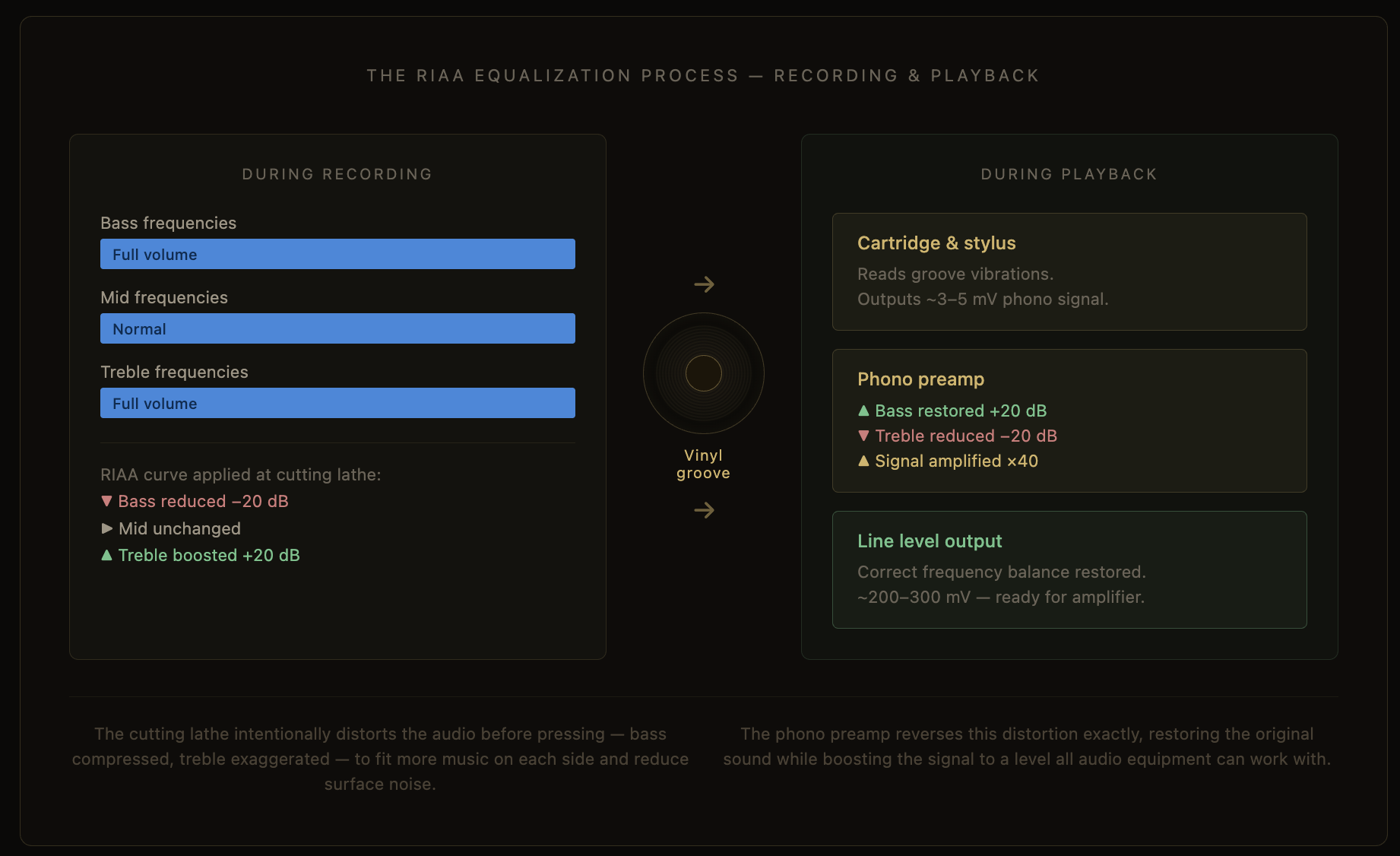
During recording, the cutting lathe deliberately reduces bass by 20dB and boosts treble by 20dB before cutting the groove. This makes the groove narrower (more music fits) and buries treble-range noise below the boosted music signal.
During playback, the phono preamp reverses this exactly — boosting bass back up and rolling off the treble — while simultaneously amplifying the whole signal from millivolt phono level to standard line level. The music comes out sounding as it was recorded, with correct frequency balance and usable volume.
Skip the phono preamp and connect a turntable to a regular input, and you’ll hear the RIAA-encoded signal raw — bass almost absent, treble wildly over-emphasized, and volume at about 2% of normal. People often describe it as “tinny,” “hissy,” or “like a telephone.” That’s not the sound of vinyl. That’s what RIAA distortion sounds like uncorrected.
How to Check If Your Phono Preamp Is Already Covered
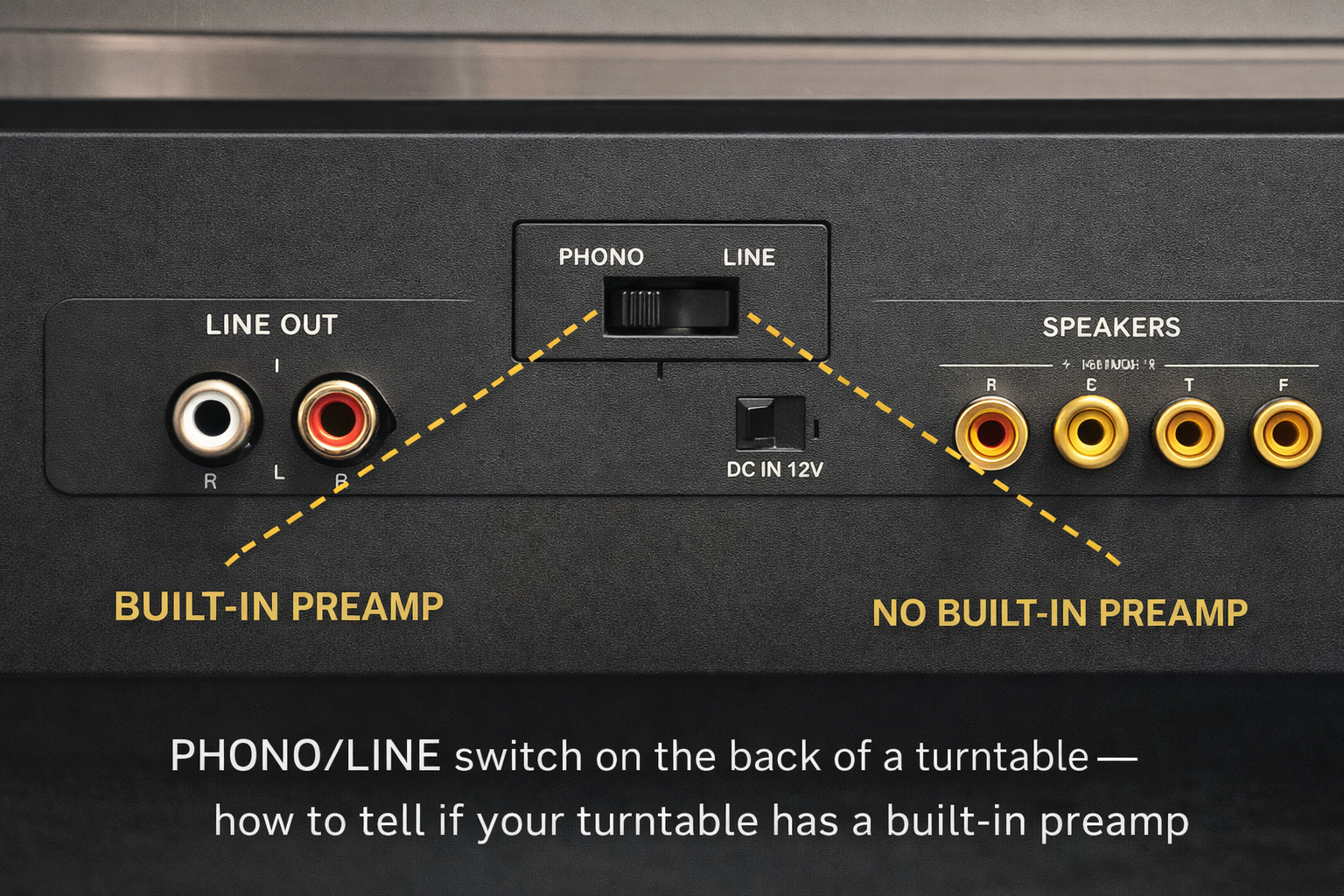
Most beginners already have a phono preamp somewhere in their setup — they just don’t know where to look. Work through these four scenarios:
Never connect a turntable to a regular AUX, CD, or Line input unless the turntable has its own built-in preamp set to “Line.” These inputs expect line-level signal. A raw phono signal connected here produces the tinny, quiet, tonally wrong sound that makes people think their equipment is broken — and misses the RIAA correction entirely.
Built-in vs Standalone Phono Preamp — Does Quality Differ?
Yes — and this is where it gets interesting for those who care about sound quality.
A built-in preamp is convenient and perfectly adequate for casual listening. Turntable manufacturers include them to make the product easier to use. But there are compromises: space inside the turntable is limited, components are budget-grade, and the preamp circuitry sits close to the motor and other electrical components that can introduce noise.
A standalone phono preamp — a separate box, typically $30 to $500+ — can use larger, higher-quality components, better shielding, and more precise RIAA accuracy. The difference is audible when you’re listening critically: quieter noise floor, more accurate bass response, better imaging.
You don’t need one if: you’re a casual listener, your turntable has a built-in preamp, and you’re using powered speakers or a modern amplifier. The built-in preamp will sound great.
Consider one when: you hear a faint hum or noise floor through your speakers, you’re using a higher-end cartridge whose quality the built-in preamp can’t fully resolve, or you’re connecting to a vintage amplifier that lacks a phono input. Even a $40 external preamp (like the Behringer PP400) will outperform most built-ins.
Where the Phono Preamp Lives in Each Arkrocket Turntable
Every Arkrocket turntable includes a built-in phono preamp. This is one of the key engineering decisions that separates Arkrocket from truly budget products — and means you never have to think about this step:
If you ever want to bypass the built-in preamp and use a higher-quality external stage, the RCA outputs on the Huygens and Cassini accept direct phono connection — check the rear panel settings and your turntable’s manual for the correct switch position.
The phono preamp is not optional — it’s a required part of every vinyl setup. But “required” doesn’t mean “extra purchase.” If your turntable, amplifier, or powered speakers already include a phono stage, you’re covered. The critical thing is knowing where it lives in your chain and making sure the signal passes through it. Once you understand this, a whole category of vinyl frustration (faint sound, wrong tone, hum) becomes immediately diagnosable.
Interested in the products mentioned? Shop Arkrocket directly:
Browse Arkrocket Record Players →