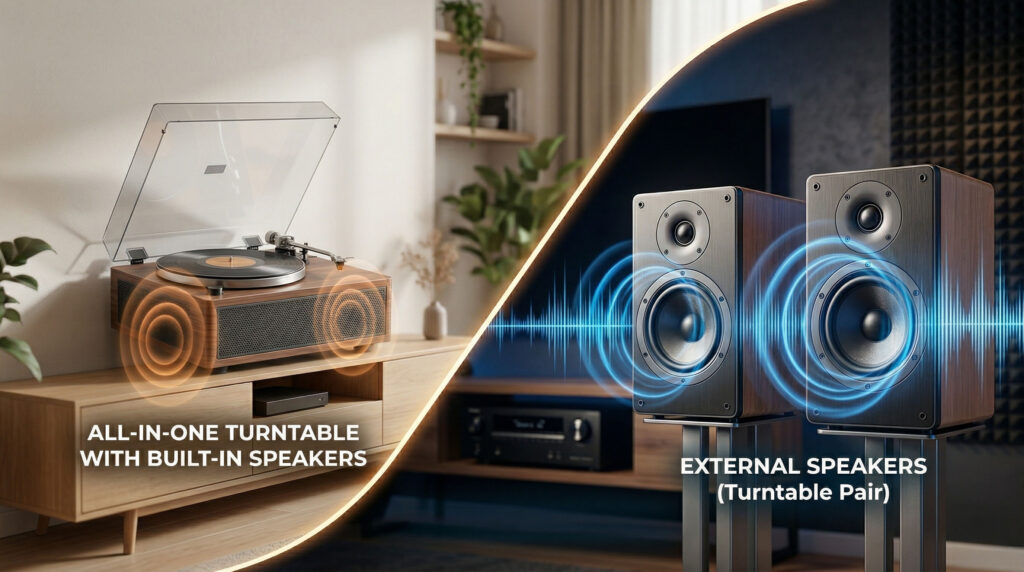
It depends on which turntable you buy. All-in-one turntables with built-in speakers — like the Arkrocket Huygens — work straight out of the box. Component turntables — like the Audio-Technica LP120X or Pro-Ject Debut Carbon — require external speakers and usually a phono preamp. Neither approach is wrong. But the total cost and the setup complexity are very different, and most beginners don’t realize this until they get home.
This is the question that trips up more first-time vinyl buyers than any other. Someone buys a turntable at a record store, gets home, plugs it in — and hears nothing, or a faint, barely audible signal at best. The turntable needs speakers. And the speakers need an amplifier. And depending on the turntable, it might also need a phono preamp just to get the signal to an audible level.
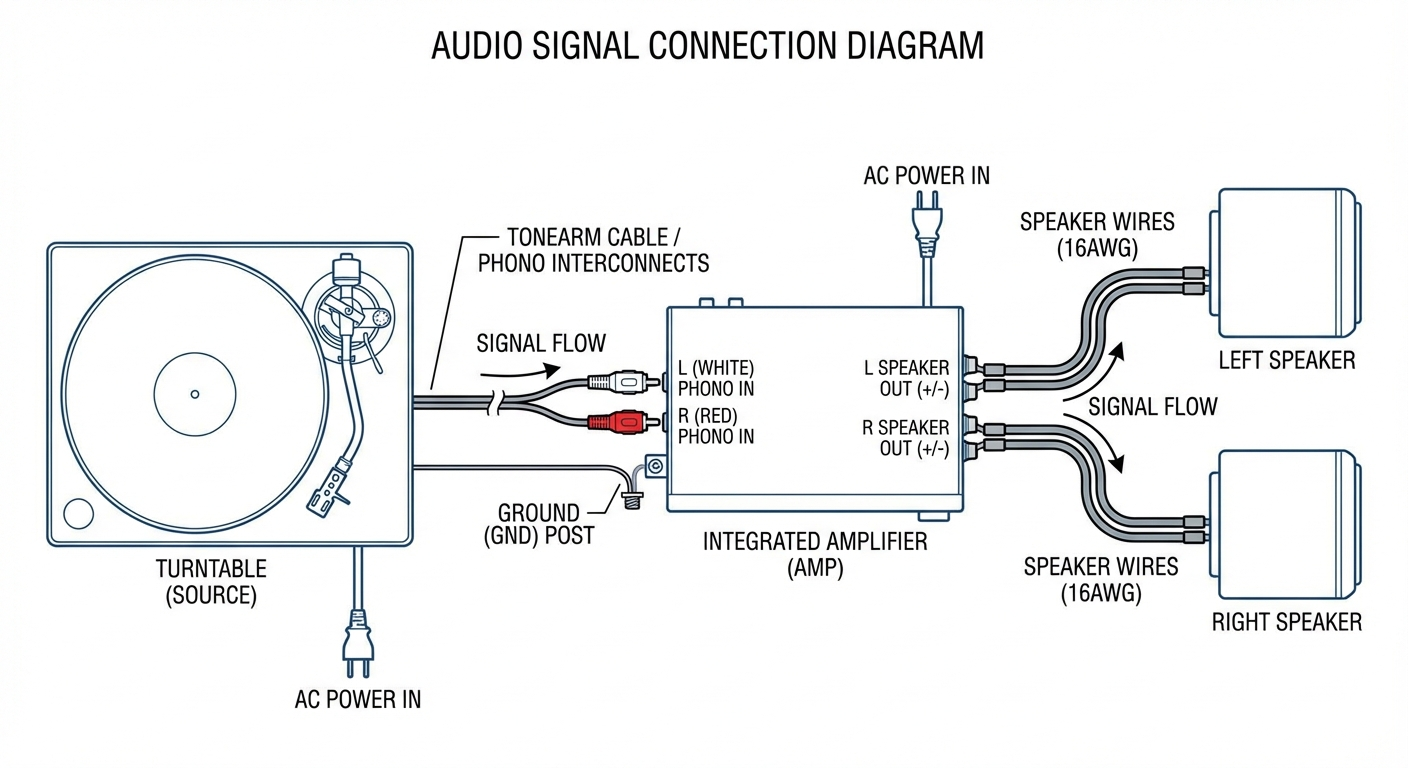
Understanding the signal chain — the path your music takes from the record groove to your ears — makes all of this instantly clear. Once you see the chain, every buying decision becomes obvious.
How Sound Gets from Groove to Speaker
Every turntable setup, no matter how simple or complex, follows the same path:
The highlighted boxes in red are what a bare component turntable is missing. You need to provide them — either by buying powered speakers with a built-in preamp, by buying a separate amplifier with a phono input, or by buying a standalone phono preamp plus amplifier plus speakers.
Every Possible Setup, Explained
Best for beginners
Why the Huygens sounds excellent — but the Cassini still sounds better
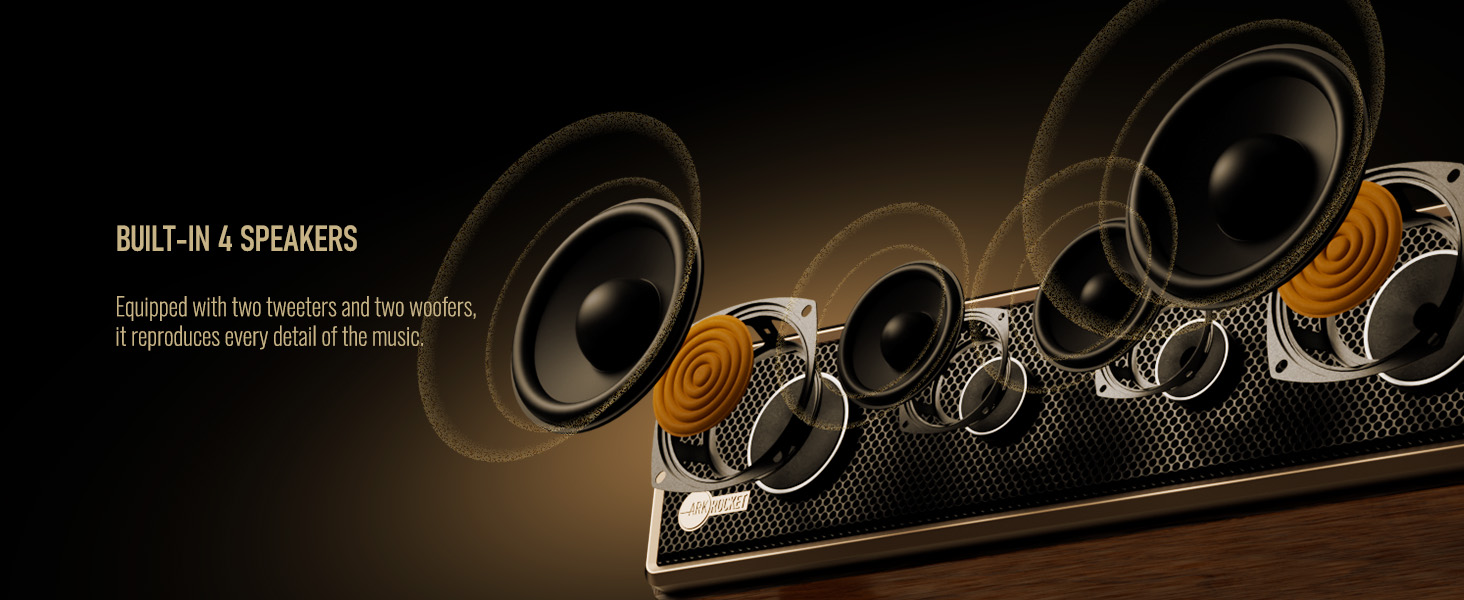
The Huygens represents what happens when engineers take the all-in-one constraint seriously. Its triple shock-absorption system, metal platter, and 30W speaker array are the result of careful acoustic engineering — not an afterthought. Among every turntable with built-in speakers on the market, it is the best-sounding option at any price.
But physics imposes a hard limit that no amount of engineering can fully overcome: the speakers and the stylus share the same cabinet. When a speaker moves, it produces vibrations. Those vibrations travel through any shared structure — chassis, platter bearing, tonearm — and reach the stylus, which picks them up and replays them as noise, or worse, causes micro-skipping at the groove level.
The Huygens’ shock-absorption system significantly reduces this — but it cannot eliminate it entirely. To protect playback quality, the built-in amplifier and speaker system are deliberately calibrated to operate below the threshold where vibration feedback becomes audible. This is a precision engineering trade-off, not a cost-cutting decision. More power means more vibration means more interference with the stylus — so the output is capped at exactly the level where music quality and record protection remain in balance.
When the Cassini’s bookshelf speakers are physically separate from the turntable, this constraint disappears entirely. The speakers can push 40 watts, deliver deep bass, and fill the room — because their vibrations never reach the stylus. That’s why the Cassini sounds fuller and louder than the Huygens, not because one is “better built,” but because they solve a fundamentally different engineering problem. If you find yourself wishing the Huygens were louder, you are not wrong — you have simply discovered why the Cassini exists.
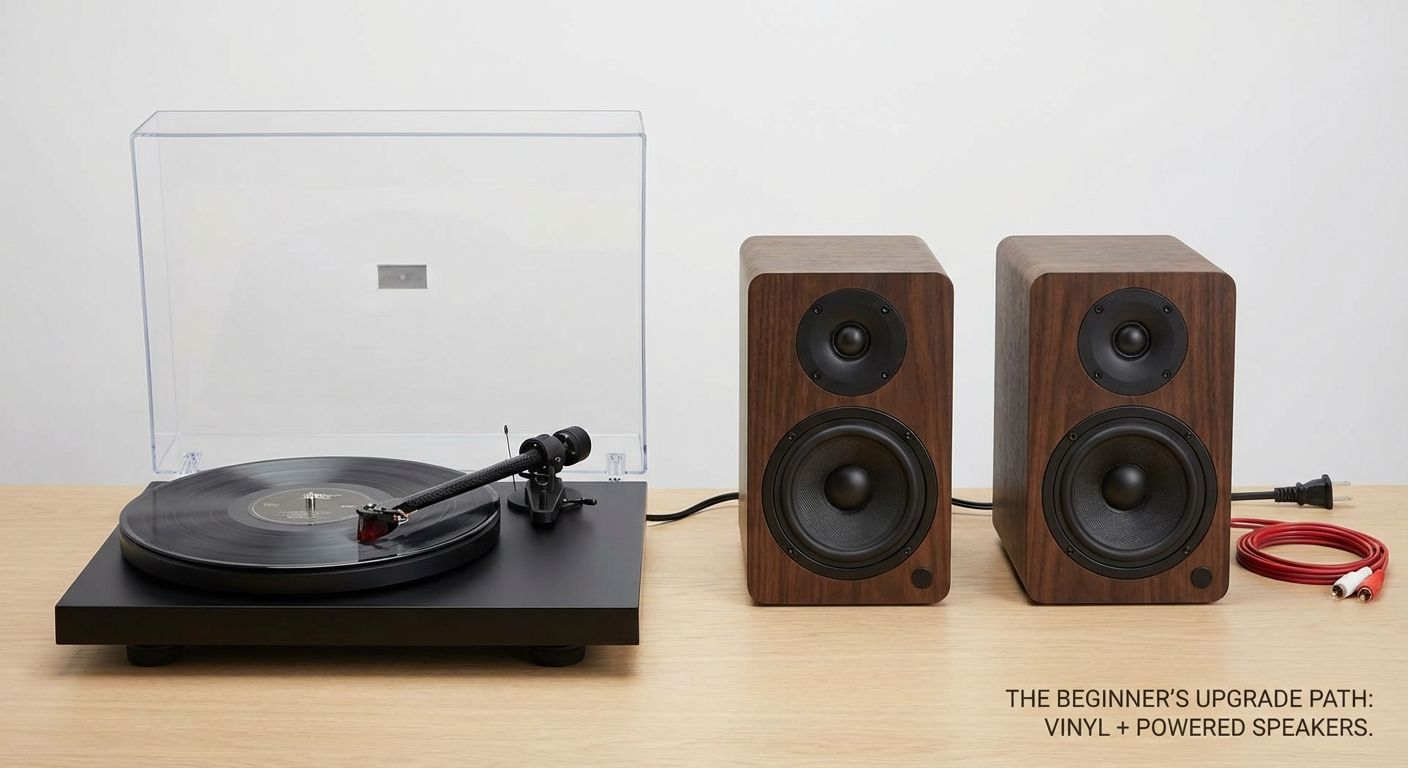
Most popular upgrade
Audiophile route
Simplest wireless
The Phono Preamp — The Thing Nobody Tells You About
A turntable cartridge produces an extremely weak signal — much weaker than any other audio source. A CD player, a phone, a streaming device all output what’s called a “line level” signal. A turntable outputs a “phono level” signal that is about 40 times quieter.
The phono preamp’s job is to amplify the signal up to line level and apply the RIAA equalization curve — a frequency correction that reverses the intentional changes made to the audio during the vinyl cutting process (to fit more music on a record, bass is reduced and treble is boosted during cutting; the preamp reverses this on playback).
Without a phono preamp in the chain, you’ll either hear almost nothing, or a faint, thin, tinny sound with wrong frequency balance. This is the most common mistake first-time buyers make.
Plugging a turntable without a built-in preamp directly into powered speakers or a regular amplifier’s AUX input. You’ll get very quiet, tonally wrong sound — and think the turntable or speakers are defective. They’re not. You’re missing the phono preamp step in the chain.
Look for a switch on the back labeled “Phono / Line” — if it has this switch, it has a built-in preamp. Set to “Line” to use the built-in preamp. Set to “Phono” to bypass it and use an external preamp.
If the back of the turntable only says “Phono” on the RCA outputs and has no switch — it has no built-in preamp, and you need to add one.
Answer Three Questions to Find Your Setup
No → Continue to question 2.
No → Continue to question 3.
No → Option 1 with Bluetooth output. Simple, flexible, good enough for most listening.
How the Arkrocket Lineup Fits These Categories
Every Arkrocket turntable includes a built-in phono preamp — so you never have to worry about the phono preamp step. The difference within the lineup is whether speakers are included:
Curiosity III ($99) — Built-in speakers, preamp, and Bluetooth. Smallest and most portable.
Coryphaeus ($159.99) — Built-in speakers, preamp, 3-speed including 78 RPM.
Discovery II ($169.99) — Built-in speakers, retro console design with removable legs.
Huygens ($289.99) — 30W built-in hi-fi speakers, Bluetooth in and out, metal tonearm. Our top recommendation.
Cassini ($329.99) and Polaris II ($389.99) pair the same quality turntable mechanism with external 40W bookshelf speakers. The turntable and speakers are physically separate — giving you true left-right stereo imaging that a single-cabinet design cannot match. Both still include the built-in preamp, so no extra components are needed.

For most first-time vinyl buyers: start with an all-in-one turntable. It removes every barrier between you and your first record. If you want the best sound and are ready to manage two boxes plus cables, a component turntable paired with powered bookshelf speakers is a worthwhile step up. The traditional separates route — turntable, amplifier, passive speakers — delivers the ultimate sound but should wait until you know vinyl is a long-term hobby. Whatever you choose, make sure the phono preamp question is answered before you buy.
Interested in the products mentioned? Shop Arkrocket directly:
Browse Arkrocket Record Players →